What Is an AI Agent–and When Does Your Agency Actually Need One?
80% of agencies use AI tools, but 68% have no AI roadmap. A Zapier automation isn't an agent. Neither is your chatbot. That distinction determines if your 25-person team can handle 18, or even 50, clients. Here"s what every digital agency needs to know.
Georg Singer··16 min read
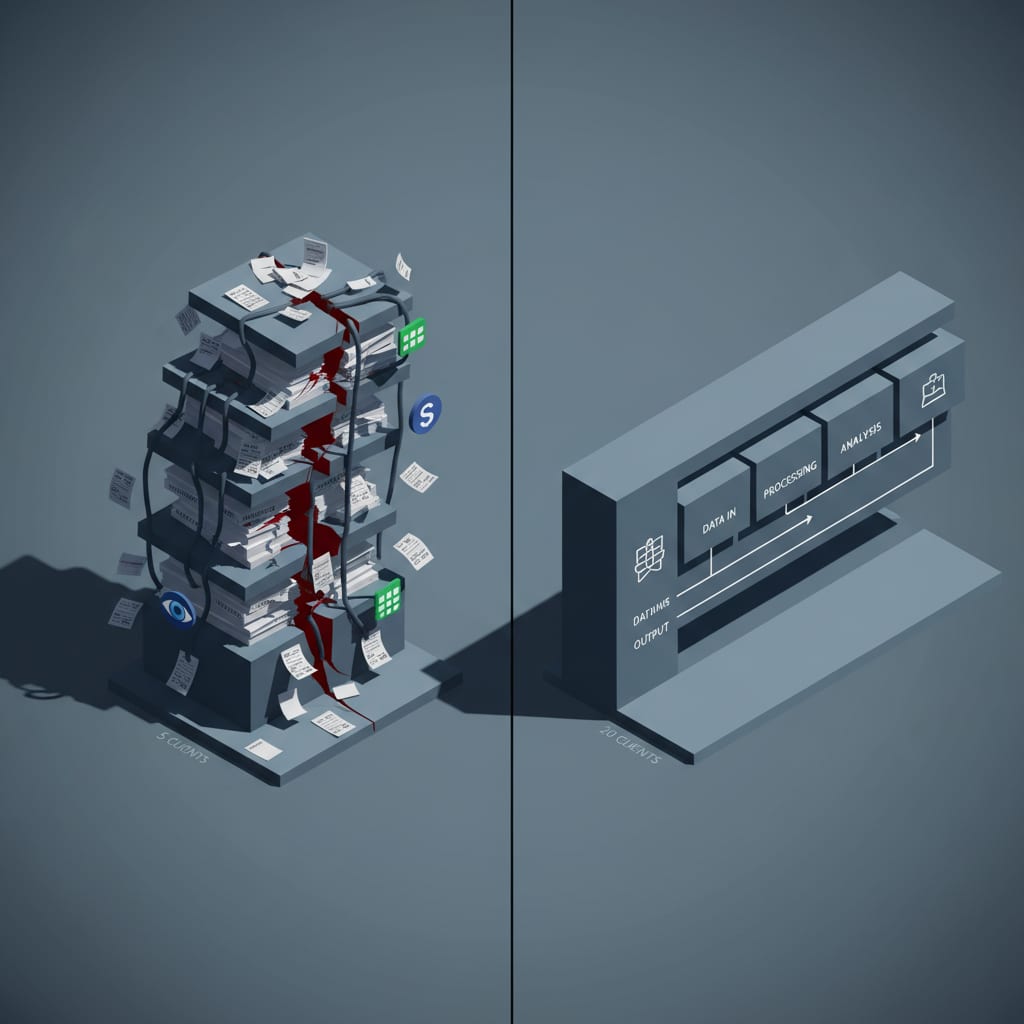
Last month, an agency owner vented on Reddit:
"My systems worked at 5 clients… now at 18 they're completely broken."
– r/GoHighLevelForum, Score 73
Sound familiar? He had Zapier automations. An onboarding chatbot. A dozen Google Sheets macros. He thought he"d cracked agency automation. He hadn"t.
And he"s not the only one facing this.
Did you know that 80% of German digital agencies are already using AI tools–yet 68% still lack a proper AI roadmap? (DIHK 2026) That"s not a contradiction. It"s a perfect snapshot of widespread confusion. What looks harmless at 8 clients becomes a full-blown operational crisis at 18.
Here"s the catch: The difference between a macro, a chatbot, and a real AI agent isn"t just technical–it"s existential for your agency"s business model.
TL;DR: Why This Matters (and Fast)
Let"s hit the headlines before we go deeper:
According to DIHK 2026, 80% of agencies use AI tools, but 68% have no roadmap; most confuse basic automation with actual AI intelligence. AgencyAnalytics Benchmarks 2024 reveals that account managers spend an average of 14.5 hours per week just on reporting, which is nearly half a full-time role–gone. A real AI agent is given a goal, not a step-by-step script, and figures out which data sources to query, and in what order, all by itself. Any macro-based system breaks down beyond 10+ retainer clients because exceptions multiply faster than your team can keep up. Reporting automation slashes time from 15–20 hours/month to 2–3 hours, according to AgencyAnalytics, which translates to 137 hours a month, per agency, that you get back.
If you"re nodding, it"s time to see if your "automation" is really just a house of cards.
Myth #1: "We Use Zapier–So We"re Already Doing AI Automation, Right?"
Let"s start with a tough question: Is your agency"s automation just a series of "if this, then that" dominoes?
Zapier is a fantastic tool. Same goes for Make. They absolutely solve real problems–as long as nothing unexpected ever happens.
But here"s where it unravels.
Macros and trigger-based workflows run on rigid if-then rules. There"s no thinking, just switching. If Channel A reports X, then do Y. If a value is missing, a format changes, or the client"s name isn"t typed exactly right–everything stops. Usually, nobody notices until the client asks why their report hasn"t shown up for two weeks.
A comment from r/SaaS nails it:
"What tools do agencies use to manage clients without duct-taping five tools together?"
– r/SaaS, Score 56
That"s the problem, summed up better than any white paper.
How Is a Zapier Automation Different from an AI Agent?
A Zapier automation follows fixed if-then rules and halts at any exception. An AI agent is given a goal–and then figures out the steps and tools needed, even as the data landscape shifts month to month.
This is not a matter of degree. It"s a fundamental difference: Macros execute. Agents decide.
Here"s where the pain sets in: 59% of agencies juggle 4–15 tools at once (Gartner Martech Survey 2025), and a third want to shrink that stack. Over on r/agencynewbies, someone asked: "What"s the most time-consuming task that clients don"t realize takes so long?" (Score 82), and the answers were overwhelmingly "Reporting."
Let"s get concrete. According to BestClick Studio, a single Google Ads report takes 125–165 minutes to build by hand. For 8 clients, that"s 240 hours a year–about €19,200 in burned capacity at an €80 hourly rate.
Zapier can reduce that, at first. But when you reach 18 clients, everything changes. Exceptions start to snowball: Client 9 wants their report in a new format, Client 12 added an extra Google Ads account, and Client 16 switched from Meta to TikTok. Every exception means manual intervention. Those "quick fixes" erase your time savings–and every manual tweak is a non-billable hour that eats directly into your margins. The more your scope creeps, the more your profit shrinks.
Here"s what that really looks like for a team of three account managers handling 15 clients: 63% of agency staff spend more than 10 hours per week on reporting, with the average being 14.5 hours per week (AgencyAnalytics Benchmarks Report 2024). Do the math: 3 managers × 14.5 hours/week × 48 weeks × €80 = €166,560 per year in capacity costs. That"s not just a full-time role–it"s almost two. But that"s not even the expensive part.
What Can a Macro Actually Do–And Where Does It Break?
Here"s a side-by-side look at what you really get:
| Criteria | Zapier/Make Automation | AI Agent |
|---|---|---|
| Input type | Structured, pre-defined | Structured + unstructured |
| Exception handling | Stops, needs manual fix | Interprets context, keeps going |
| Tool access | Hardwired, static | Dynamic, task-driven |
| Scaling to 18+ clients | Linear upkeep, every exception = work | Client-isolated, scales without duplicate workflows |
| Typical agency task | "Form submitted → Slack message" | "Create October report for Müller GmbH using GA4, Ads, and Search Console" |
When your client list is small, static workflows hold up. But as soon as things get messy–and they always do–macros fall apart.
Next up: Let"s talk about chatbots and why they"re not your answer either.
Myth #2: "Our Website Chatbot–That"s an AI Agent, Right?"
Picture this: It"s Tuesday. Your chatbot is answering client questions on your website. But your account managers are still buried in reporting hell.
Let"s be brutally honest: A website chatbot doesn"t solve a single internal efficiency problem for your agency.
Yes, it can answer visitor questions. Maybe it qualifies leads. But it"s not an agent, and it won"t help your team survive the weekly reporting grind.
Here"s the core difference, in one sentence: A chatbot responds to questions. An AI agent executes tasks–across multiple steps and systems–on its own.
Real Agency Example
- Chatbot: A client asks, "When will my monthly report be ready?" The bot replies, "Your report is in progress."
- AI Agent: Gets the goal "October report for Müller GmbH." It logs into the GA4 account, pulls conversion data, pings the Google Ads API, analyzes performance vs. last month, writes a structured summary with three recommendations, and hands the draft to the account manager for review–with zero human steps in between.
What Separates a Chatbot from a Real AI Agent?
A chatbot reacts to single inputs and spits out canned (or slightly personalized) answers. An AI agent **pursues a goal across several steps, connects to outside tools, and delivers a finished result–**not just an answer.
For agencies, only the AI agent is a genuine efficiency booster. The chatbot? It"s just another communications channel.
Here"s the thing: Client transparency is what makes or breaks agency relationships. Most clients don"t leave because of bad results, but because they feel left in the dark about ongoing work. An AI agent that delivers the same, structured, white-label report every month at the same time creates more transparency (and trust) than three hours of manual labor that varies by manager and mood. For a practical example of what this looks like, see the overview at AgencyAnalytics Benchmarks 2025.
"Does automated reporting improve client relationships–or does it kill transparency?"
– r/AgencyGrowthHacks, Score 61
Fair question. The honest answer: Transparency comes from consistent, on-time reports–not from hours spent cobbling together PDFs. A report that arrives every month, identically structured and on time, wins more trust than a half-done PDF three days late.
And according to AgencyAnalytics Benchmarks 2025, 55% of clients are considering switching agencies in the next six months–and the number one reason isn"t poor performance, but bad communication.
So what does this mean for your agency? The reporting problem is really a communications problem. And your website chatbot isn"t the solution.
Let"s move on to what actually counts as an AI agent.
SwiftRun automates repetitive workflows with AI agents – so your team can focus on what matters.
What Actually Is an AI Agent? (And Why the Definition Matters)
The term "AI agent" is slapped on everything these days–from simple web forms to complex automation pipelines. But for agencies, here"s the only definition that really matters:
An AI agent is a software system that receives a goal (not a step-by-step script), autonomously plans the required steps, and calls external tools, APIs, or data sources to achieve that goal–even when unexpected exceptions pop up. A macro gets an instruction. An agent gets a mission.
By contrast:
An AI pipeline (workflow) is a pre-structured sequence where AI models follow a rigid set of steps–every tool call and action is predefined. The pipeline always takes the same path for the same input. For agencies, pipelines are a pragmatic entry point: more powerful than static macros, more controllable than free-roaming agents.
So what turns a system into a true agent? Three things:
- Goal, not instruction: You say, "Create a monthly report for Client X," not "Step 1: open GA4, Step 2: export data, Step 3: paste into template…"
- Autonomous planning: The agent figures out what data sources it needs and in what order–even as sources and formats change.
- Tool access: It connects to external systems–GA4, Google Ads, Search Console, your CRM–without anyone manually wiring them up. If there"s no real integration, it"s just a smart form, not an agent.
Is something "agentic" or not? It"s not black-and-white–it"s a spectrum. For example, n8n with an LLM node is technically possible, but without client isolation and monitoring, it"s fragile in real life.
Anthropic"s research on agent architectures (Building Effective Agents, 2024) draws a clear line between "workflows" (fixed diagrams with LLMs) and true agents that decide which tools to invoke in real-time.
If you don"t have an in-house dev team, preconfigured workflows are the realistic way in. That"s not a contradiction–it"s just the first rung on the agent ladder.
Before & After: What Monthly Client Reporting Looks Like
Let"s make it real:
Before: Account manager manually exports GA4 data. Opens Looker Studio. Adjusts the date filter. Notices Supermetrics hasn"t synced for three days. Waits. No one talks about it, but everyone knows. Pulls from Google Ads instead. Rebuilds the table in Sheets. Writes the summary. Formats the white-label PDF. Sends it off. Total time: 2–3 hours per client, times 15 clients. This workload never shows up in the capacity plan–but it"s a full-time job in disguise.
After: Account manager gives the agent a goal: "October report for Müller GmbH." The agent pulls every data source, analyzes deviations, drafts prioritized recommendations. Manager reviews, tweaks two sentences, sends it out. Total time: 20 minutes.
This isn"t hypothetical. According to AgencyAnalytics, reporting time drops from 15–20 hours per month to just 2–3 hours after automation–freeing up an average of 137 hours per month, per agency.
And that"s just reporting.
Myth #3: "AI Agents Are for Big Corporates–Not Agencies Like Ours"
Here"s a stat that should make you pause: 95% of agency staff at firms with 10–50 people regularly work overtime. (trusted.de) Burnout isn"t rare–it"s baked into this segment. And it"s not because your people aren"t working hard enough. The real culprit? Processes built for five clients that collapse at twenty.
So if you think AI agents are just for enterprise behemoths, think again.
Is an AI Agent Worth It for a 15–30 Person Agency?
Short answer: Absolutely. Agencies with 15–30 staff are the sweet spot for AI agents.
Here"s why:
- At 10+ retainer clients, any macro-based reporting system collapses under the weight of exceptions.
- Reporting automation frees up an average of 137 hours per month–even without a developer on staff.
- That"s 0.8–1.2 full-time roles unlocked, just in client reporting, with no extra hires.
Big agency networks have developers, data engineers, and enterprise contracts (with five-figure annual fees). Freelancers and micro-agencies (up to 10 people) can still limp by with Notion, Airtable, and a Zapier subscription.
But the 10–50 employee segment? Too big for freelancer tools, too small for enterprise platforms–and right at the stage where manual processes scale painfully.
The numbers back it up: According to ibusiness.de, revenue share for mid-sized agencies (rank 11–50) dropped from 42.2% in 2023 to 34.7% in 2025/26. The efficiency gap is cutting right through this segment–not because of lack of creativity or talent, but because operational overhead grows with every new client.
And just when you need your tools the most, they start to break down. On r/PPC, an agency owner writes:
"Supermetrics forcing legacy customers onto new pricing models–anyone else affected?"
– r/PPC, Score 56
They"re not alone. According to G2, connector failures are the second most common complaint about Supermetrics, and price hikes in April 2024 ranged from 40–60%–with no new features (Whatagraph/acuto.io).
But that"s just the surface.
There"s another cost driver few talk about: Scope Creep.
- 57% of agencies lose €920–4,600 per month (~$1,000–5,000) in unpaid extra work that nobody ever officially requested.
- Only 1% consistently bill for out-of-scope work (The Drum, May 2025).
- 48% of agencies say tracking billable hours is their biggest operational pain point.
AI agents won"t fix scope creep overnight. But they do make it crystal clear how many hours are really going into reporting–giving you the leverage to plan capacity and push back on hidden work.
Mini Case Study: Reporting Agent at a 3-Manager Agency with 15 Clients
Let"s break it down:
- A performance marketing agency with three account managers and 15 retainer clients (anonymized).
- The team spent a combined 56 hours per week just on reporting. (Wayfront)
- That"s a full-time role you never posted, but pay for every month.
How they started:
- Deployed a reporting agent for the five highest-revenue clients using a preconfigured platform (no devs needed).
- Two weeks to set up, then straight to business.
The result after two months?
- Reporting time for those five clients dropped from 18.5 to 2.8 hours per week.
- The freed-up time went into strategy reviews and new business, not more overtime.
- That"s a 0.4 FTE equivalent saved for five clients–scaling up to all 15 clients means about 1.2 full-time roles freed up, just from automating reporting.
And in 2026, you don"t need a dev team to do this. Self-hosted platforms like SwiftRun run on a standard VPS and are fully configurable–no coding required. These tools are built precisely for the 10–50 staff segment.
If you want to see exactly how a reporting agent setup works (without developers), SwiftRun has a step-by-step guide.
Now, let"s answer the big question: How do you know if your agency actually needs an AI agent?
When Does Your Agency Really Need an AI Agent?
A recent r/DigitalMarketing thread asked:
"How much time does your team spend on client reporting each month? Is it still a painful process?"
– r/DigitalMarketing, Score 82
The answers? Ranged from 8 to 20 hours a week. Not a single "no, it runs smoothly."
So, how do you know when to make the jump?
Rule of thumb: A task is ready for an agent if it:
- (1) Happens regularly,
- (2) Has a clear goal,
- (3) Requires variable inputs,
- (4) Touches multiple tools or systems.
Decision Matrix: Pipeline, Agent, or Human?
Wondering what to automate–and what to leave to humans? Here"s your cheat sheet:
| Task | Recommendation | Rationale | Cost/Run (approx.) | Time Saved |
|---|---|---|---|---|
| Monthly client reporting | Agent | Variable data sources, clear goal, 15× monthly | €0.80–2.50 | 2–3 hrs/client |
| Content briefing creation | Agent/Pipeline | Structured goal, variable research sources | €0.50–1.50 | 60–90 min/briefing |
| Client inquiry triage | Pipeline | Predictable format, fixed escalation logic | €0.10–0.30 | 30–60 min/day |
| Competitor analysis | Agent | Unstructured sources, needs interpretation | €1.50–4.00 | 3–5 hrs/analysis |
| SEO audit | Agent | Many data sources, needs recommendations | €2.00–5.00 | 4–6 hrs/audit |
| Creative campaign strategy | Human | Not automatable without quality loss | – | – |
70% of typical reporting tasks are automatable–analyzing, explaining, generating recommendations–according to Databox (cited by Wayfront). The rest? They still need a human touch. But that"s not a contradiction: The agent drafts, the account manager approves. Those 20 minutes of review are worth far more than three hours of data-wrangling.
Five Quick Questions–Is It Time to Start Using AI Agents?
If you answer "yes" to three or more, you"re overdue:
- Is your team spending more than 10 hours a week on reporting?
- Do you have more than 8 retainer clients?
- Do your Supermetrics or Funnel.io connectors regularly create data gaps–or have you ever only discovered a connector failure days later?
- Does the quality of your white-label reports vary by who creates them?
- Do your Zapier automations run smoothly–for every client, all the time, with zero manual correction?
⚠️ Heads up–The Multi-Agent Trap: The most common mistake isn"t waiting too long–it"s getting overexcited. Agencies that launch five agents for five different tasks at once create more headaches than they solve. Anthropic"s research strongly recommends: Start with the single task that delivers real value–usually, that"s reporting. Biggest pain, clearest goal, fastest measurable ROI. Once that"s rock solid, move to the next.
A Controversy Worth Clearing Up
Is n8n with an LLM node an AI agent? Technically, yes. But in real-world production? It"s fragile. Without multi-tenant isolation, all your client data lives in the same context. An error in Workflow A can corrupt data in Workflow B.
A multi-tenant agent means an AI agent that keeps data cleanly separated for each client–no cross-contamination. For agencies with 10+ retainer clients, this is the architectural line between "works in demo" and "works in production."
Nearly half (48%) of agencies say tracking billable hours is their biggest operational pain, per AgencyAnalytics. If you process client data in a shared context, you"re also risking GDPR violations–very real when 15 clients run through the same n8n workflow.
So, What"s the Real Solution?
Here"s the reality: 95% of agency staff in the 10–50 employee segment work overtime–not because you"re understaffed, but because the wrong infrastructure is scaling. (trusted.de)
The answer isn"t another hire. It"s a new architecture.
The real question for your agency isn"t, "Are we already using AI?" It"s: Which of our processes still need a step-by-step script, even though the goal never changes?
If the answer includes reporting, content briefings, or first-line client triage–then in 2026, agent infrastructure isn"t a dev project. It"s a decision.
Wayfront estimates 70% of typical reporting work is now automatable. The tech is ready. The platforms don"t need developers. What"s missing? Usually, just the decision of where to start.
56 hours a week on reporting isn"t a strategy. It"s an invisible full-time role you never hired for–but pay for every single month.
Ready to reclaim those hours and scale your agency efficiently? SwiftRun.ai gives you pre-built AI agents for tasks like reporting and content briefing. Start free – no credit card required.
Author: Georg Singer
AI agent agencywhat is an AI agentagency automation AIchatbot vs AI agent differenceAI agents software for agencies
Related Articles

Digital Agencies
EU AI Act: What Agencies Using AI for Client Work Need to Know
80% of German digital agencies already use AI tools–but starting August 2025, 'deployers' face new legal duties that most agencies aren"t prepared for. Here"s what really changes for you by August 2026–and how to avoid costly mistakes.
Jul 31, 2026·13 min read·Georg Singer

Digital Agencies
What Legal Risks Do You Face When Using AI in Client Projects?
80% of German digital agencies already use AI tools–but almost none have a data processing agreement (DPA) with their AI providers. That"s not a small oversight; it"s a GDPR risk that can cost up to 4% of annual revenue.
Jul 30, 2026·16 min read·Georg Singer

Digital Agencies
The Ultimate GDPR Guide for Agencies Using AI with Client Data
Does your agency run client data through AI workflows? You"re a data processor under GDPR–no written DPA, no mercy. Fines up to €10 million await. Here"s a 6-step, practical guide to fix your compliance in just 2 hours.
Jul 29, 2026·17 min read·Georg Singer