Self-Hosted AI for Sensitive Data: Why It Matters
Still pasting client data into ChatGPT as a consultant or accountant? Here's why that's more dangerous than you think–and how self-hosted AI protects you (without needing your own server).
Georg Singer··13 min read
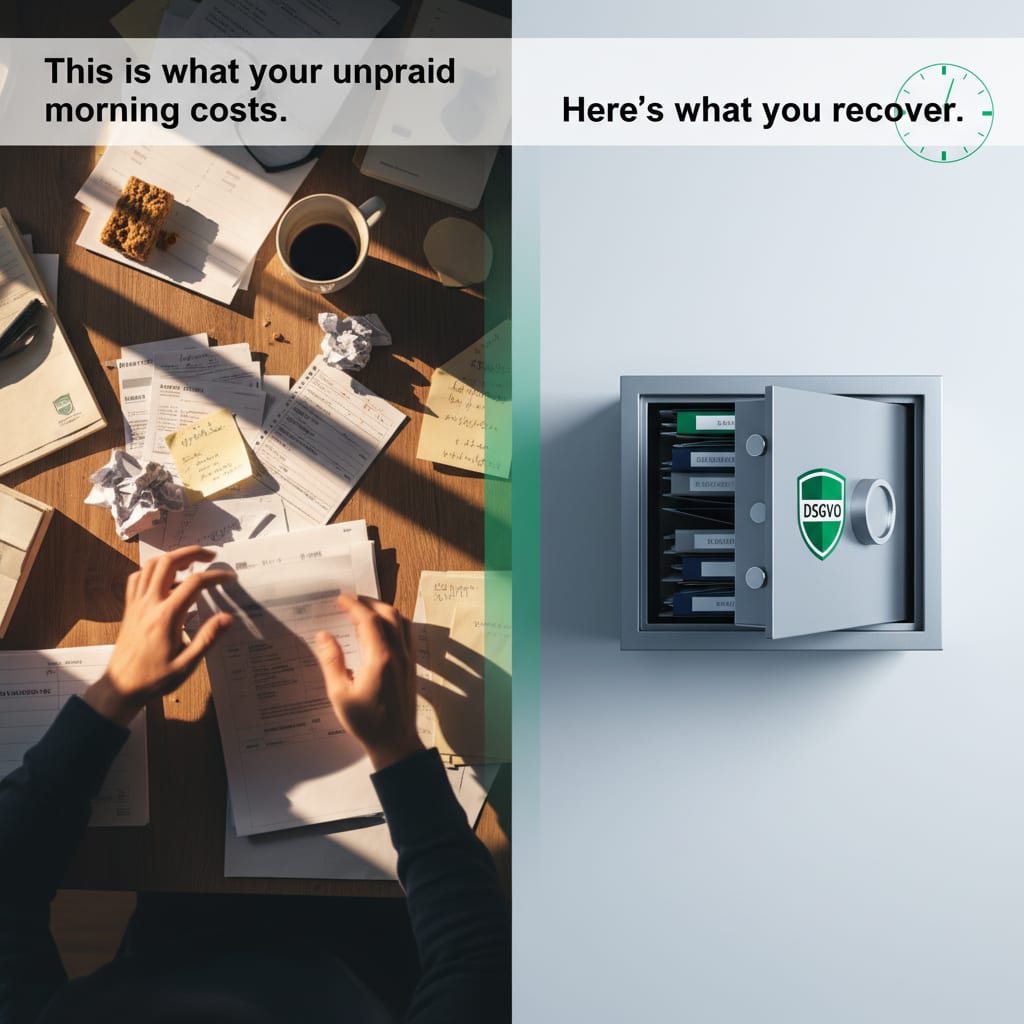
85% of freelancers in Germany are already using AI tools. Yet the vast majority don't have a Data Processing Agreement (DPA) with the vendor. That's not an oversight–it's an open §203 StGB risk that gets played with every single day.
Let's break down why this matters–especially if you're an accountant, lawyer, or consultant handling sensitive client data.
Key Takeaways
- 85% of freelancers use AI tools, but only for "safe" tasks due to unclear legal situations, with only 4% finding their reporting process fully sufficient.
- Entering client data into standard ChatGPT versions risks a §203 StGB violation, as data is processed on US servers without a DPA.
- Self-hosted AI does not require personal server hardware; GDPR-compliant EU hosting with a DPA is sufficient.
- Professional, secure AI solutions can cost €50–150/month, a small price compared to losing a client over a privacy incident.
- Anonymizing data is often insufficient if the business context and key figures remain visible, still posing a risk.
What Actually Happens When You Put Client Data in ChatGPT
Ever wondered what really happens the moment you paste a client spreadsheet or sensitive email into ChatGPT? The stakes are higher than most consultants realize.
Where Do Your Inputs Go? The Hidden Journey of Your Data
Here's the simple, uncomfortable truth: Any info you enter into ChatGPT's free or Plus versions is processed on OpenAI's servers–primarily in the United States. Unless you have an Enterprise contract and have specifically toggled off data training, your input can be used to improve their models. That's more than just a privacy issue.
For anyone handling confidential client data, it's a legal minefield. Let's walk through what happens with a real example.
Suppose Markus, a consultant, uploads a client dataset into ChatGPT to draft a report.
- Your data leaves Europe. OpenAI's main data centers are in the US. Every time you use the standard ChatGPT interface, you're triggering a data transfer to a "third country."
This instantly triggers strict requirements under GDPR Article 44+. That's not just an IT thing; it's a legal obligation.
OpenAI treats its web interface and API differently. Most consultants don't realize this. Using the ChatGPT website comes with one set of privacy rules, while using the API is another story. Unless you're on Enterprise and you've actively disabled data training, your inputs may be used for model improvement. It's all spelled out in the OpenAI Privacy Policy.
No Data Processing Agreement, no protection. GDPR Article 28 requires a DPA for any third party processing personal data on your behalf. OpenAI only provides this in its paid Enterprise segment–not in the product 85% of users actually use.
"Five people entered data from the same document into five different systems. None of them checked a data processing agreement."
– @zain_hoda on X, 494 Likes
This isn't just a one-off mistake. Consultants often use new tools on gut instinct, only thinking about the legal side (if at all) once it's too late.
According to Workstorm Research (2025), 72% of freelancers still manually consolidate reporting data from multiple sources–even when they're already using AI for other tasks. Only 4% say their reporting process is fully sufficient. The #1 reason cited: uncertainty about which tools are actually compliant with data protection laws. That's the real productivity killer.
But the technical details are just the start. The real risk isn't about where your data goes–it's what happens if the law gets involved.
§203 StGB, GDPR, and Professional Ethics: What Are You Really Risking as a Consultant?
Imagine this: You're a lawyer, accountant, or auditor. Can you legally use ChatGPT or other AI tools for client work?
Here's the answer most don't want to hear: No–not without serious legal safeguards.
Why Consultants with Confidentiality Obligations Are in the Danger Zone
§203 StGB explicitly forbids professionals with legal confidentiality obligations from disclosing client secrets to third parties. That includes US-based AI vendors who don't have a GDPR-compliant DPA. For consultants in law, tax, or audit, this isn't a theoretical risk–it's a direct criminal liability.
⚠️ Heads up:
§203 StGB doesn't just apply to lawyers, accountants, and auditors–doctors and "other confidentiality-bound professionals" are covered too.
There's no "I didn't know" defense. If you say, "I didn't realize pasting into ChatGPT counted as data disclosure," the judge isn't interested.
§203 StGB – Violation of Private Secrets: This law applies to lawyers, accountants, auditors, doctors, and others with professional confidentiality. It bans unauthorized disclosure of client secrets to third parties–including US AI vendors without a valid DPA. You don't have to intend to break the law; ignorance won't protect you.
The German Federal Chamber of Tax Advisors (BStBK, FAQ on AI Use in Tax Consulting, 2024) states it outright: tax advisors must respect their professional secrecy obligations when using AI tools. Hardly anyone reads this document, but the message couldn't be clearer.
What about management consultants or other advisors who don't have statutory confidentiality? The risk changes–but doesn't go away. If you've signed an NDA with your client (and in consulting, that's the rule, not the exception), then leaking client data to an uncontrolled third party is a breach of contract. The risk here is civil, not criminal–but losing a client stings just as much.
If you've ever had to justify your hourly rate to a client who says, "But AI does this for free," you need a real answer–not every AI result is legally or professionally acceptable. AI hallucinations in client reports, connector glitches in your data sync, a missing manual check: these are the quality issues where your expertise still matters.
Let's put numbers to this. The average consultant loses 2.9 hours per day to inefficient time tracking (Ledgrix / ActiveCollab). At €150/hour, that's €435 lost per day. An average consulting engagement in the DACH region brings in €15,000–€50,000 per year (based on prevailing rates). A single data protection incident that costs you a client wipes out years of AI tool savings. The risk is asymmetric–and you only need to get unlucky once.
Fee pressure is real: DACH freelancers" average monthly income dropped from €8,432 (2025) to €6,653 (2026)–a 21% year-over-year plunge (starting-up.de, 2026). If you lose even more clients over a privacy breach, you're losing your financial cushion.
Freelancer-Kompass 2026 by freelancermap.de (5,400+ surveyed) found that 59% of freelancers still do all admin manually. Community feedback says it's not by choice–it's because they're unsure which AI tools are actually compliant. That's the real drag on productivity.
Now that we've seen how the legal risks stack up, let's talk about one of the most common "workarounds" consultants try–and why it usually doesn't work.
Does Anonymizing Data Before Using AI Actually Protect You?
Here's the reality: Anonymization only works if re-identification is truly impossible. In practice, that's rare. If you're combining industry context, financial metrics, and project descriptions, it's shockingly easy to figure out who's involved. As long as anyone could link the pieces back to a specific person or company, the legal risk remains. Anonymization isn't a get-out-of-jail-free card.
So, if pasting into ChatGPT is a minefield and simple anonymization doesn't cut it–what can you do differently? That's where "self-hosted AI" comes in. But what does that actually mean?
Self-Hosted AI in Plain English: What It Is–and What It Isn't
Ask three consultants what "self-hosted AI" means, and you'll get three different answers. Here's what you really need to know–especially if you're not a techie.
Self-Hosted AI: The Consultant's Definition
Self-hosted AI means running your AI models on servers controlled by you–or by a contracted EU-based provider. The key is that your data never flows to OpenAI, Google, or Microsoft's own infrastructure without your explicit consent. No uncontrolled data transfers to third countries, and a proper DPA is in place.
Think of it this way: using self-hosted AI is like running your own office server, while using ChatGPT is like storing client files on Dropbox. With Dropbox, they control where the files live. With your own infrastructure (or a trusted EU partner), you decide.
But here's what self-hosted AI doesn't mean:
- You don't need to buy your own data center.
- No need to configure a Linux server.
- You don't have to code.
- No hiring IT staff.
Most modern self-hosted solutions are really SaaS products running in an EU data center. The real difference isn't the technology–it's data residency (where your data physically lives) and the contract (who has legal access).
Why does this matter so much? Because 72% of freelancers (Workstorm, 2025) don't trust AI tools with client data, even though they use AI for everything else. The main reason: they just don't know which self-hosted solutions are actually GDPR-compliant–and which are just marketing.
There's one version of "self-hosted" that's often misunderstood: local models you run on your own laptop, like via Ollama. Technically, these are great for privacy–data never leaves your device. But in real-world consulting, they're a headache: no backups, no remote access, no monitoring, and they're brittle (one OS update and your setup could break). "Secure but unstable" isn't a business model you can scale.
Self-hosted AI means your language model runs on servers you or your EU-based provider control. No uncontrolled data transfers abroad, and you can sign a GDPR-compliant data processing agreement.
Now that we've cleared up what self-hosted AI is (and isn't), let's talk about the real-world options for consultants–costs, effort, and how much protection you actually get.
SwiftRun automates repetitive workflows with AI agents – so your team can focus on what matters.
The Four Realistic Self-Hosted AI Options for Solo Consultants: Cost, Effort, and Protection
You don't need to be a tech wizard to get secure, compliant AI. But not every option is right for every consultant. Here's what's on the menu for solo advisors who want to avoid "AI roulette" with client data.
Comparing the Real-World Choices
| Option | Cost/Month | Setup Effort | Data Protection Level | Best For | Main Risk |
|---|---|---|---|---|---|
| ChatGPT Enterprise | ~€28 ($30 as of Mar 2026) | Minimal | Medium – Training off, but US servers | Consultants without legal secrecy, non-sensitive data | CLOUD Act: US agencies can demand access |
| Ollama local | Free | High | High – Data never leaves device | Tech-savvy solos, not for production | Instability, no backup, no remote access |
| EU Cloud w/ DPA (e.g. Azure EU + OpenAI Service) | €30–80 | Very high | High – if configured correctly | Teams w/ IT resources | Complex setup, config errors possible |
| Self-hosted agent platform (e.g. SwiftRun.ai) | €50–150 | Minimal | Very high – EU data center, DPA included | Solo consultants, small teams, no devs | Vendor dependency |
A quick note about ChatGPT Enterprise: This tier disables training on your data, partially solving the GDPR issue. But it doesn't fix the §203 StGB problem. US providers are subject to the CLOUD Act, which means US agencies can demand access to your data–even if it's physically stored in the EU. For professionals bound by confidentiality, that's legally insufficient.
And it's not just about compliance–tool stability matters, too. Popular reporting tools like Whatagraph are notorious for connector instability, requiring frequent manual fixes. Self-hosted platforms with EU hosting are far more stable and easier to manage without a dev team.
The critical question isn't, "Which tool has the shiniest features?"
It's: Which one lets you sleep at night after processing client data?
So, how do you know when you actually need a self-hosted AI?
Decision Tree: When Do You Really Need Self-Hosted AI as a Consultant?
85% of freelancers say they use AI tools regularly (Freelancer-Kompass 2026). Yet 66% admit AI has had no significant impact on their billing rates. Why? Most are only using AI for "safe" stuff: drafting, research, public content–never for real client data.
But does it have to be this way? Let's make the decision process concrete:
| Scenario | Role | Data Handled | Risk Level | Recommendation |
|---|---|---|---|---|
| 🟢 A | Consultant, no confidentiality, only public data | No personal or sensitive data | Low | ChatGPT Plus (turn off training) is fine |
| 🟡 B | Consultant w/ NDA, sometimes internal company data | Occasional personal data | Medium | EU-hosted AI with DPA needed |
| 🔴 C | Tax advisor, lawyer, auditor, regular client data | Confidential financial, personal, or privileged info | High | Only self-hosted or certified EU solution with DPA |
"Explain what your inputs are, what the output should look like, where the data sits–and how you handle duplicates."
– @VibeMarketer_ on X, 528 Likes
This is the question every consultant should ask before using any tool. Most don't.
Here's a quick checklist for your next AI tool setup:
- Am I processing personal data from my clients?
- Am I legally bound by professional secrecy (lawyer, accountant, auditor)?
- Have I signed NDAs with my clients?
- Do I know exactly where the tool stores its data?
- Is there a signed Data Processing Agreement with the provider?
If you answer "yes" to three or more, you don't need to debate: You need an EU-compliant, self-controlled solution.
Now, let's look at what this means for your day-to-day workflow.
What Self-Hosted AI Actually Changes for Your Consulting Practice
Let's revisit Markus, a consultant in Munich, three months after he recognized the legal risk in his workflow.
Before:
Six hours of admin per week–four of them unbillable. Client data runs through US systems. §203 risk is real, but he's oblivious. He sleeps well–because he doesn't know what's at stake.
After:
Same tasks, done in two hours. Client reporting is automated. Data flows are combined without manual double-checks. Everything sits in an EU data center, with a signed DPA. The real difference isn't speed–it's that Markus can finally sleep well, knowing he's not risking his business.
The real value of self-hosted AI isn't privacy for privacy's sake. It's the freedom to finally use AI for your core work–offer analysis, client reporting, email classification with real data. Not just harmless side tasks like drafting public newsletters.
With GDPR-compliant AI, you can automate client reporting without sending sensitive data to US servers. You can merge data sources without endless manual checks. Build offer analyses across multiple clients–scalable, without a dev team. Here, data protection isn't the goal; it's the prerequisite for modern consulting.
"In a few months, every founder will have agents running their ads. Many agencies will quietly lay off their execution teams and reinvent themselves as strategy consultants," writes @EXM7777 on X, 302 Likes. If you're only using AI for harmless tasks, you're already falling behind.
Almost 50% of freelancers spend about six hours a week on unbillable admin, according to Clockify (2025). At €120/hour, that's €34,000 in lost annual income. With GDPR-compliant AI, you can turn some of those hours into billable time: automate client reporting, merge data sources, and keep client data off US servers. Defending your hourly rate also means not wasting your time on grunt work that a tool could do in seconds. If you haven't crunched these numbers yet, you haven't really considered your AI setup.
But let's be honest: self-hosted models are usually smaller than GPT-4. For complex reasoning or huge documents, they may lag a bit. For core consulting tasks–structured analysis, reporting text, client emails–modern EU-enabled models are more than good enough.
The true cost of risk: §203 breach → Lost client → €15,000–€50,000 annual revenue gone. A self-hosted agent platform costs €50–150/month–that's at most €1,800/year. Just one privacy incident more than cancels out years of these costs. That's not a prediction–that's arithmetic.
So, if you see yourself in Markus's shoes–using AI, but uneasy about sensitive client data–you're not being paranoid. It's a sign your legal setup isn't right yet. For a full overview of which AI tools are actually GDPR-compliant for consultants, see the guide at.
The good news? This is solvable. No server racks, no dev team, no months of implementation.
Try SwiftRun.ai for free – EU hosting, GDPR-compliant, zero setup
self-hosted ai softwareself-hosted ai consultancygdpr ai consulting§203 StGB aiclient data ai secure
Related Articles

Freelance Consultants
Stay Current: Expert Consulting Tips, Save Time
85% of freelancers use AI tools, but almost none have a system to turn that into billable expertise. If you're losing 40,000€+ a year in wasted knowledge work, here's how to fix it–in just 2 hours" setup.
Aug 5, 2026·14 min read·Georg Singer

Freelance Consultants
Connect AI to CRM in Under 60 Minutes
Still manually copying data between your CRM and email? 72% of freelancers are, even though linking HubSpot or Pipedrive to an AI platform takes less than 60 minutes–no developer needed. Here's how you can automate away hours of admin, stay GDPR-compliant, and scale smarter.
Aug 5, 2026·14 min read·Georg Singer

Freelance Consultants
How Often Should You Update Your AI Agent as a Consultant?
Is your AI agent quoting outdated prices or suggesting grants that no longer exist? This isn't a hallucination issue–it's a maintenance problem. Here's how to build an effortless update routine that keeps your agent's knowledge (and your reputation) sharp.
Aug 1, 2026·13 min read·Georg Singer