Build AI Onboarding: Marketing Team in 3 Days
Your new colleague asks about ROMI–again. Outdated Notion boards and Slack chaos slow onboarding to a crawl. Here"s how AI agents can slash ramp-up time from weeks to days, automate marketing knowledge, and keep your team (and sanity) intact.
Georg Singer··16 min read
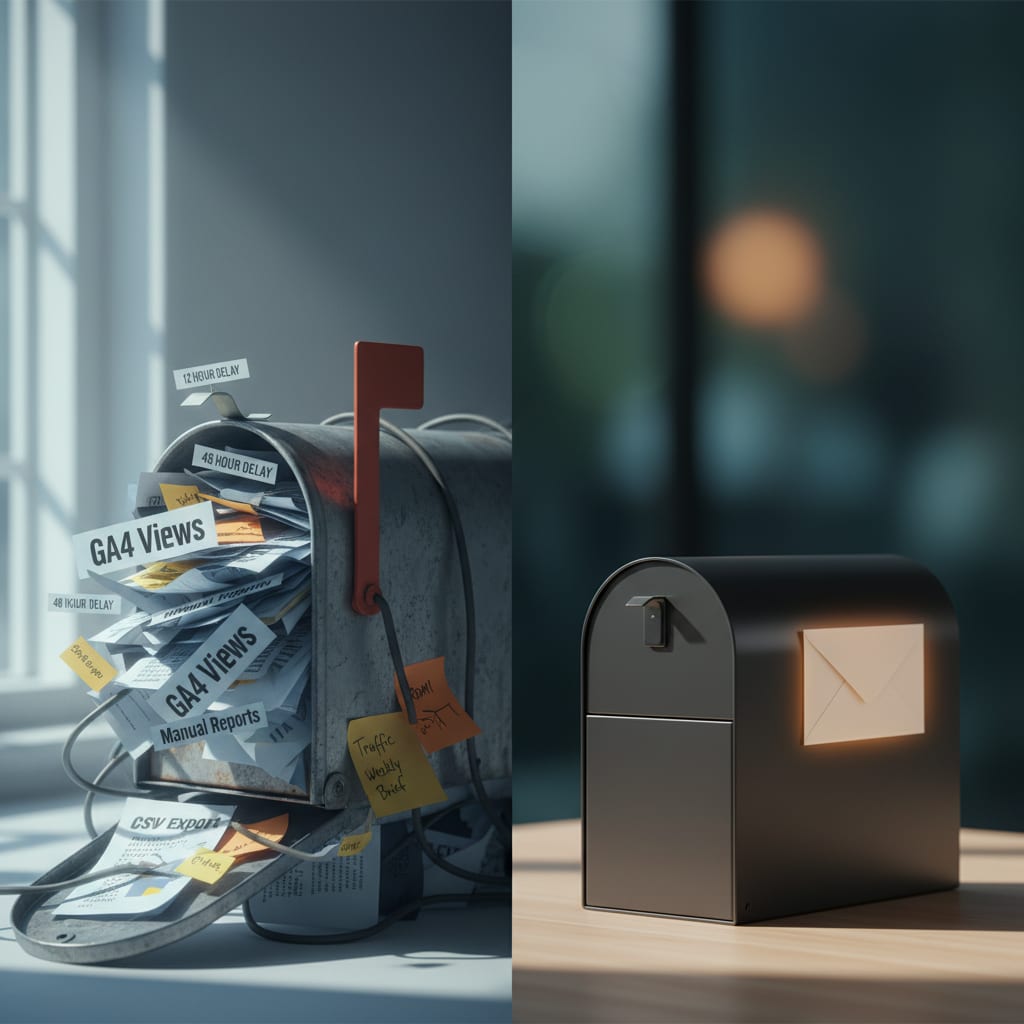
Monday morning, 9:24 AM. Your new hire is asking–yet again–what"s the difference between ROMI and attribution. Slack DMs are piling up. The onboarding Notion board is two quarters out of date.
In your head, you"re hearing that Reddit line: "GA4 is a disaster for SaaS teams and we"re all pretending it"s not." Why does onboarding still feel like it"s stuck in 2015, when AI agents can now handle your reporting, content pipeline, and knowledge management?
Quick Takeaways: What You Need to Know
Onboarding with AI agents can shrink ramp-up time for SaaS marketing teams from 2 weeks to just 2–3 days (BeastMetrics). This means your new marketer is productive before you"ve even gotten to Friday standup.
Furthermore, 58% of marketers feel overwhelmed, and 51% are emotionally burned out–mostly because onboarding is fragmented and chaotic (Marketing Week). These scattered processes aren"t just annoying; they"re burning out your team.
Adding to the inefficiency, only 49% of paid martech tools actually get used (Gartner). An AI agent centralizes your team"s knowledge and workflows, so you"re not paying for ghost tools. This automation saves 20–30 hours per month, and SaaS teams cut onboarding effort by up to 80%–with zero engineering help (BeastMetrics). That"s like getting an extra week back, every month.
But beware: Outdated knowledge bases, missing quality control, and privacy (GDPR) issues don"t magically disappear. AI agents are powerful, but they"re not a replacement for human oversight.
Why Classic SaaS Marketing Onboarding Is Broken (and What It"s Really Costing You)
Ever wonder what inefficient onboarding is actually costing your team?
Let"s be real. Classic onboarding is a maze: Notion boards, Google Docs, random Slack DMs, and a Monday ritual of screenshots, spreadsheets, and "did-you-get-the-login?" check-ins. New hires take 4–6 weeks to hit productivity. In between, you get knowledge gaps, data silos, endless ROMI questions, and that sinking feeling you"re always two steps behind.
Before & After:
- Old way: Manual onboarding. 14 days, 5 different tools, 8 potential failure points. The Notion doc is outdated, the new hire types "ROMI" wrong, and can"t log in to reporting. Slack is on fire.
- New way: AI agent. 3 days, 1 central interface, error rate drops by 80%. Your new hire gets personalized tasks, learns attribution, and by Day 3 is building custom explorations in GA4.
But that"s just the user experience. The real pain? The hidden costs and errors that show up when you least expect.
What Are the Main Problems with Classic Marketing Onboarding in SaaS Teams?
Classic onboarding is a mess–unstructured, scattered across too many tools, and a massive time sink. The result? Weeks of wasted ramp-up, critical knowledge falling through the cracks, and overwhelmed team members. Errors in data ownership or GA4 setup sneak in, and you only notice when the CFO"s Monday report is due.
"GA4 is a disaster for SaaS teams and we"re acting like it isn"t." – Reddit r/SaaS (source)
"I found out I was wasting €370 ($400) a month on Facebook Ads when I switched from GA4 to a €6.50 ($7) analytics tool." – Reddit r/GrowthHacking (source)
"GA4 attribution is a total joke for my SaaS." – Reddit r/SaaSMarketing (source)
GA4"s complexity isn"t just a meme–it"s a daily struggle for teams. Only 37% of companies trust their analytics data enough to make strategic decisions (ALM Corp). Meanwhile, 95% of CMOs are under pressure to prove ROMI, with CFO scrutiny up 52% since 2023 (CMO Survey 2025). No surprise that 75% of SEOs and marketers are unhappy with GA4 (SE Roundtable).
And here"s the kicker: GA4 gives you just 17 standard reports out of the box–Universal Analytics had over 115 (Search Engine Journal). For a mid-sized SaaS team without a dedicated analytics engineer, you"re looking at weeks of manual tweaking before you get anything actionable.
"GA4 isn"t just complicated–it spits out incomplete or even contradictory data. The attribution chaos drives us all nuts." – YouTube comment from a marketing analytics expert (see video)
Here"s what it means for your team: 58% of marketers feel overwhelmed, and 51% report emotional exhaustion–especially in smaller teams with heavy onboarding burdens (Marketing Week Career Survey 2025). That"s not just about mood; it"s about retention and output.
From my own experience: Most SaaS teams vastly underestimate how much tacit knowledge is lost during onboarding–and how much that bottlenecks your ability to scale.
Now that you know why the old way fails, let"s look at how AI can actually fix it.
What"s an Internal AI Agent for Onboarding? (And Why It"s So Much More Than a Chatbot)
Picture this: Instead of a static checklist, your new team member gets a smart, interactive guide that answers questions, explains concepts, and even checks their understanding–all in real time.
What Makes an AI Agent Different from Classic Automation Tools?
An internal AI agent is an autonomous software assistant that actually "gets" your team"s processes, teaches knowledge, and runs routine marketing tasks on its own. This isn"t just workflow automation (like Zapier) following rigid, pre-set rules. An AI agent responds to context, learns from interactions, and takes repetitive work off your plate.
For example: Instead of just getting a Notion checklist, your new hire has a conversation with the agent. Ask about multi-touch attribution? The agent explains the concept, pulls an example from your own stack (Looker Studio, GA4, BigQuery), and checks for understanding on the spot.
"AI agents are like a teammate who never calls in sick and knows every process in your team by heart." – LinkedIn comment, SaaS marketing lead
But here"s the catch: 52% of companies lack the know-how to implement AI meaningfully in marketing (Bitkom Study 2026). If you"re not careful, you"ll just swap one set of headaches for another.
Key distinction: An onboarding AI agent is designed specifically to guide new hires contextually and process-wise through every step in your marketing workflow–adapting to their needs, not just running through a script.
So, how does this actually look in a real SaaS marketing team? Let"s walk through it, step by step.
How an Onboarding AI Agent Works for Marketing Teams: The Real-World Workflow
Imagine this: You want your new marketer up and running in days, not weeks. With an AI agent, onboarding becomes interactive, tailored, and (almost) effortless.
What"s the Difference Between Manual and AI-Driven Onboarding?
Here"s what changes: With an AI agent, onboarding shrinks from 2 weeks to just 2–3 days. Your agent delivers personalized tasks, instant answers, and checks for knowledge gaps–no more hunting through outdated docs or chasing Slack threads.
Step-by-Step: From Newbie to Productive in Record Time
Manual process: Request access → read Notion board → set up tool logins by hand → ask questions in Slack → wait hours (or days) for answers → make attribution/ROMI mistakes → report via copy-paste rituals → finally tackle real tasks after 2 weeks
With AI Agent: Get access → AI agent greets, walks through onboarding → interactive quizzes on attribution, custom explorations, ROMI → agent simulates reporting, checks understanding → real-time alerts if something"s off → productive output in 2–3 days
Table: Onboarding With vs. Without AI Agent
| Criteria | Manual (14 days) | AI Agent (3 days) |
|---|---|---|
| Time required | 14 days | 3 days |
| Error points | 8 (logins, reporting, definitions) | 1 (usually a knowledge gap, caught instantly) |
| Tools used | 5+ (Notion, Slack, GA4, Sheets, Email) | 1 central interface (e.g., SwiftRun.ai) |
| Time to productivity | 2 weeks | 3 days |
| Satisfaction (1–10) | 4–6 | 8–9 |
The payoff: Automation saves 20–30 hours every month; onboarding time drops by up to 80% (BeastMetrics.io). That"s real time you get back–for you and your team.
"We cut onboarding from 14 days to 3 because the AI agent explained and ran everything that used to be spread across five tools." – Micro-case study, SaaS marketing team
Now that you"ve seen the workflow, let"s break down what your AI agent actually needs to know–and how you can build that knowledge base without a single line of code.
SwiftRun automates repetitive workflows with AI agents – so your team can focus on what matters.
What Kind of Knowledge Base Does an AI Agent Need? (And How to Build It Without Developers)
Let"s tackle the big question: How do you give your AI agent everything it needs–without dragging in your dev team?
How Do You Build and Maintain a Marketing Knowledge Base for Your AI Agent?
Good news: A marketing knowledge base for AI agents should cover FAQs, processes, tool details, and best practices. With no-code tools like Notion, Slite, or the platform, you can structure and update everything on your own–no engineers required.
A knowledge base is simply a centralized, structured hub for all team-relevant info (from FAQs to best practices) that your AI agent can draw from, and that everyone updates over time.
Blueprint: How to Structure and Keep Your Knowledge Base Fresh
Key sections to include:
- FAQs on ROMI, attribution, GA4, Looker Studio
- Step-by-step process docs (content pipeline, reporting, lead scoring)
- Tool logins and troubleshooting guides
- Best practices: naming conventions, data ownership, cookieless tracking
- Context protocols for advanced marketing flows
Updating is easy:
- Any team member can suggest changes
- Hold a 20-minute review session monthly
- Add new findings right away
- Use versioning like in Google Docs for full transparency
No-code tools to use: Notion, Slite, the platform–all accessible, no API knowledge needed.
"Everything winds up in Slack again if you don"t actually maintain the knowledge base."
– Reddit r/SaaSMarketing
Here"s the kicker: Only 49% of paid martech tools are actively used–knowledge management is often just too complicated (Gartner 2025). If the knowledge base isn"t maintained, your AI agent is just as useless as that dusty Notion board.
Checklist: What Your AI Agent"s Knowledge Base Needs
- FAQs for every core term (ROMI, attribution, PLG, lifecycle emails)
- Clear process docs (content, reporting, CRM marketing)
- Documented tool logins and access protocols
- Troubleshooting and best practice guides, with data ownership policies
- Clear responsibilities and update cycles
- Versioning with date stamps and change logs
Armed with a living knowledge base, your AI agent can actually help new hires–not confuse them. But what tasks can it really take over? Let"s explore.
What Can an Onboarding AI Agent Actually Do in Marketing?
Wondering if an AI agent can really handle your team"s onboarding? Let"s get concrete.
What Marketing Tasks Can an Onboarding AI Agent Handle for a SaaS Team?
Here"s what"s possible: An onboarding AI agent can explain your content pipeline, simulate reporting flows, and walk new hires through lead nurturing. It"ll handle routine questions, fact checks, and tool onboarding–no developer intervention needed.
Three Real-World Scenarios: Content, Reporting, Lead Nurturing
Scenario 1: Content Pipeline The AI agent explains how your team plans content, walks through steps from keyword research to publication, and checks that the new hire gets how brand storytelling and product-led growth (PLG) work together.
Scenario 2: Reporting No more Monday screenshot marathons (GA4 → Sheets → Slack). The agent generates a weekly analytics brief, spots anomalies (like traffic drops or attribution mess-ups), flags them proactively, and teaches how to build custom explorations in GA4.
Scenario 3: Lead Nurturing The agent guides new hires through CRM marketing workflows, simulates lifecycle emails, explains lead scoring, and shows how to deliver hyper-personalized journeys in your martech stack–including zero-click searches and pipeline attribution.
"The agent didn"t just explain our content pipeline–it actually walked me through the process." – Onboarding feedback, SaaS newcomer
Big picture: AI agents are already running entire marketing workflows–from onboarding to lead scoring (Bitkom Study 2026). But some tasks still need a human touch.
Checklist: What Can the AI Agent Do–And What Still Needs a Human?
- ✓ Explain processes (content, reporting, lead nurturing)
- ✓ Answer routine questions and provide fact checks
- ✓ Tool onboarding (GA4, Looker Studio, CRM)
- ✓ Spot anomalies in reporting
- ✗ Provide empathy, build team culture, set personal goals
- ✗ Handle escalation for uncertainty or complex conflicts
So, what"s the catch? There are risks and limits with every automation. Let"s break them down–so you don"t fall into the same traps.
Risks, Pitfalls & Limits: What AI Agents Can"t Do (and How to Spot Trouble Early)
Think automation solves everything? Here"s where it can go badly wrong.
What Are the Main Risks and Limitations of Using AI Agents for Onboarding?
Here"s the simple truth: Risks include outdated knowledge bases, missing feedback loops, and privacy headaches (especially with GDPR). An AI agent is not a total substitute for a real human mentor–it takes care of the routine, but quality control is still your job.
⚠️ Heads up: No AI agent is better than its data. If your knowledge base is outdated, your new hire learns the wrong process–and nobody notices until the next Monday report is wrong again.
Common mistakes:
- Outdated info in the knowledge base
- No way for new hires to give feedback
- Over-automation: onboarding feels cold, team culture suffers
- GDPR and data ownership issues (e.g., personal data in US clouds)
- High data latency causing late alerts and bad decisions
The reality: Nearly 40% of all GA4 properties have misconfigured events, tanking data quality (Trackingplan 2026). Plus, 65.7% of marketing ops leads report data integration headaches that bog down workflows (LXA Hub 2025). GDPR compliance remains a minefield–GA4 isn"t compliant by default, and you"re on the hook.
"If the agent spits out old info, the new hire believes it–and nobody notices."
– Reddit r/SaaS
⚠️ Warning: AI agents are not a substitute for human oversight. Quality control, escalation, and feedback loops are leadership"s job. GDPR and data security must be checked before you go live–otherwise, you risk data chaos and hefty fines.
Curious how to actually launch your own onboarding AI agent–without coding, in just two weeks? Let"s lay out the plan.
How to Launch an Onboarding AI Agent in 14 Days: Step-by-Step Plan & Tool Picks
Ready to move fast? Here"s how you can set up a full onboarding AI agent for your marketing team in just 14 days–no developers needed.
How Can I Roll Out an Onboarding AI Agent for My Marketing Team Quickly?
You"ll want a clear phase plan: Collect knowledge, set up the agent, run a pilot, and iterate. With tools
Phase Plan: 14-Day Rollout
Week 1: Build Your Data Foundation
- Review existing Notion boards, Google Docs, and Slack threads
- Transfer content into a central no-code knowledge base (the platform, Notion, or Slite)
- Assign ownership for ongoing updates
Estimated effort: 1–2 days, 1 responsible person
Week 2: Build and Configure Your AI Agent
- Connect a no-code tool
- Integrate your knowledge base
- Test first tasks and common onboarding questions
Estimated effort: 2–3 days, no developers needed
Week 3: Pilot Onboarding & Optimization
- Have a new hire go through onboarding with the agent
- Gather feedback (What was unclear? What was missing?)
- Refine the knowledge base and tweak processes
- Track: time to productive output, error rate
Estimated effort: 2–3 days, hold a review call after 1 week
ROI Calculation (Simple Example):
If you cut onboarding from 14 to 3 days, you save 11 days per new hire. At an average hourly rate of €50 and 8 hours per day, that"s €4,400 per person–multiplied by every new teammate.
"We had our first AI-guided onboarding running in 10 days–without a single line of code." – Pilot customer, SwiftRun.ai
Another bonus: Automation saves 20–30 hours per month, and SwiftRun agents deliver finished reports and alerts in 60 seconds (BeastMetrics.io). That"s before you even count the time you save on Slack DMs.
Checklist: Implementation & Quality Control
- Knowledge base filled and approved
- AI agent connected to all tools (GA4, CRM, Looker Studio)
- Pilot onboarding with a real new hire completed
- Feedback loop set up (monthly review)
- GDPR check finished
- Monitoring in place for data latency and anomaly detection
- Clear escalation processes defined
Final Thought
Why should your new team member waste 14 days wrangling with outdated Notion boards and Slack chaos–when an AI agent could onboard them in 3 days (and automate their reporting too)? Don"t wait for your next Monday report to become another pain point.
Keep reading:
- How to Automate Lead Generation and Lead Nurturing with AI Agents: A Practical Blueprint for SaaS Marketing Teams
- How to Use AI Agents as a Marketing Manager–No Coding Required
- Model Context Protocol (MCP): Why This Changes Marketing Automation Forever
Key Definitions & AI Citations
Internal AI agent: An autonomous software-based assistant that understands your team"s processes, teaches knowledge, and independently handles routine marketing tasks–unlike classic automation, which just runs predefined workflows.
Knowledge base: The structured, central hub of team-relevant information (FAQs, processes, best practices) that an AI agent uses and that gets updated continuously.
Onboarding AI agent: An internal agent that guides new hires contextually and through every process step in marketing.
FAQ Extension: Q: Why does onboarding in SaaS marketing take so long? A: Because knowledge is scattered across data silos, outdated Notion boards, and fragmented Slack threads. GA4"s complexity creates questions no one can answer on the fly. AI agents can bridge those gaps with real-time support.
Q: How secure is data privacy with an AI agent? A: GDPR-compliant AI agents use encrypted connections and never store personal data without consent. A clear data strategy and regular compliance checks are a must before going live.
Mini-Case Study: > A SaaS team of 8 switched onboarding to an AI agent. Before: 14 days to first productive reporting, 5 error points per new hire, 6 hours weekly for manual reporting. After: onboarding done in 3 days, error rate down to 1, reporting automated–no engineers needed.
Want to keep learning?
- Marketing Week Career Survey 2025
- Bitkom Study: Marketing in Digital Transformation 2026
- BeastMetrics.io Automation Case
- Gartner Martech Stack Report
- Trackingplan Analytics Errors 2026
- ALM Corp Analytics Trust 2026
- CMO Survey 2025
- SE Roundtable GA4 Dissatisfaction
- Search Engine Journal: GA4 vs UA Reports
- LXA Hub 2025
Related Articles:
- How to Automate Lead Generation & Nurturing with AI Agents: The Ultimate SaaS Marketing Blueprint
- How to Start AI Marketing Automation–Without Rebuilding Everything at Once
- How to Build an AI Agent That Replies to Customer Reviews Automatically (Real-World Blueprint for SaaS Marketing Teams)
Ready to get your marketing team up to speed with AI in record time? See how SwiftRun.ai can make building your AI onboarding process a breeze, just like we outlined!
internal ai agent onboarding marketing team knowledge baseai agent marketing onboardingsaas marketing automation
Related Articles

SaaS Marketing
AI Automates SaaS Content Production
SaaS marketing teams waste 20–30 hours every month on manual content work that doesn"t drive growth. AI pipelines change the game–not by adding more tools, but by completely rethinking your process. Here"s how.
Aug 8, 2026·16 min read·Georg Singer

SaaS Marketing
AI Agent for Automatic Review Replies: SaaS Marketing
Drowning in 470 Google reviews and tired of copy-paste replies? Here"s how SaaS marketers can use an AI agent to save 80% of their time–without risking brand disasters. Real numbers, real pitfalls, and actionable expert tips. Practical, readable, and ready to implement.
Aug 8, 2026·13 min read·Georg Singer

SaaS Marketing
How to Use AI Agents in Marketing Without Coding Skills
Over half of marketing teams fail with AI agents–not because of technical hurdles, but because they lack clear, no-code workflows. Here are three automations you can actually launch in your first week–no developer required.
Aug 7, 2026·16 min read·Georg Singer