Best AI Agents for SaaS: Numbers, Scenarios, Cost Traps
A single AI agent, 11 days online, $47,000 burned–and nobody noticed until the credit card was melting. Here's why 95% of AI agent pilots never reach production, how to choose the right agent strategy, and what to watch for–complete with real numbers, pitfalls, and decision frameworks.
Georg Singer··15 min read
Quick Takeaways
- 95% of AI agent pilots never make it to production. This is according to the Composio 2025 AI Agent Report.
- The average cost overrun is a staggering +340% when hard agent limits are not established, as detailed in the AICosts.ai Cost Crisis Guide.
- A single runaway agent burned $47,000 in just 11 days. This is a true story, not an exaggeration, as reported on Medium.
- Production-ready AI agents require observability, budget caps, and audit trails. Without these, you're stepping into a financial trap.
- Your first productive AI agent should focus on automating a well-defined, repetitive use case. Avoid chasing speculative, complex scenarios initially.
"A developer"s AI agents ran up a $47,000 bill in 11 days. Nobody noticed."
Imagine this scenario: You're running a SaaS product, your team is enthusiastic about the potential of AI agents, and suddenly, your credit card is maxed out. This happened because an AI agent you deployed was quietly racking up API calls for days without anyone noticing.
This isn't an isolated incident. According to the AICosts.ai Cost Crisis Guide, 73% of SaaS teams do not track their AI agent costs in real time. This means most teams only discover runaway costs when their monthly bill arrives, or worse, when their payment processing starts to fail.
A working demo, however impressive, doesn't guarantee production readiness. Demos often function smoothly on a developer's laptop, but the moment you deploy to real users, your system can falter and fail spectacularly. This is the infamous demo-to-production gap.
The Demo-to-Production Gap: Why 95% of AI Agents Never Go Live in SaaS
What is causing so many promising AI agent projects to fail? Why do so few transition from a quick hackathon demo to a fully functional, customer-facing SaaS feature?
The stark reality is that most AI agent projects falter in production because their initial proof-of-concept phase neglected essential elements like observability, cost controls, and basic governance.
A proof-of-concept is fundamentally different from a production environment. In a live SaaS stack, it's crucial to have visibility into what your agents are doing, how much they are costing, and the ability to trace every decision they make. Skipping these critical steps not only risks introducing bugs but also jeopardizes your entire budget and the trust of your customers.
The statistics underscore this challenge. According to the Composio 2025 AI Agent Report, only one out of every twenty generative AI pilots successfully makes it to production. The common reasons for failure are predictable, yet entirely preventable.
Lack of real-time cost tracking is a major issue, with 73% of teams only discovering their agent's expenses after the fact. There's also the absence of observability, which allows agents to quietly produce incorrect results–a phenomenon known as "silent quality degradation"–that standard monitoring tools fail to detect. Furthermore, the lack of an audit trail, termination logic, or multi-tenant isolation creates a significant compliance nightmare waiting to happen.
Frameworks like LangChain are excellent for rapid prototyping and demonstrations. However, in a real-world operational setting, 45% of developers never deploy LangChain to production. Furthermore, another 23% end up removing it later due to the associated overhead and debugging difficulties (LangChain State of Agent Engineering).
"AI agents work great in demos, then collapse under real business processes." –LangChain State of Agent Engineering, 2025
"The hard part isn"t inference. It"s building the guardrails for cost, quality, and failure in live systems." –LangChain Academy, 2026
Therefore, if your initial thought is "our prototype works, let's ship it," it's time to reconsider. The significant gap between "it works on my laptop" and "it works reliably for thousands of users" is precisely where most AI agent projects meet their demise.
Are you ready to understand the critical differences that separate a truly production-ready AI agent from a mere science project? Let's delve into the practical aspects.
Which AI Agents Actually Deliver Value for SaaS–and When?
Let's address the most pressing question every SaaS founder faces: How can you determine if deploying an AI agent is truly worthwhile?
Here"s the essential litmus test: An AI agent is valuable if it automates a well-defined, repetitive task with a clear, measurable return on investment (ROI), and if you can guarantee robust, production-grade guardrails–including observability, strict limits, and auditability. If any of these criteria are missing, you are essentially gambling with your operational costs and your company's reputation.
The difficult truth is that not all AI agents are ready for prime time. Agentic AI is a tool, not a magical solution. The same AI agent that impressed you in a demo can transform into a budget black hole, or worse, a compliance risk, the moment it's deployed into a live environment.
On average, teams experience a +340% cost overrun compared to their initial projections when they bypass essential production checks (AICosts.ai Cost Crisis Guide). This isn't just a theoretical concern; it's a tangible financial risk.
As an example, Jason Calacanis shared that his agents were incurring costs of $300 per day each, even at only 10-20% utilization. This amounted to $100,000 annually, primarily from "tokens burned on idle cycles" (X/Twitter). Such significant overhead can quickly sink a SaaS business before it even gains traction.
So, what defines a "production-ready AI agent"? It's a software component that reliably automates tasks within your SaaS environment. Crucially, it must possess built-in controls for observability, adherence to budget limits, and a comprehensive audit trail. Anything less is merely a proof-of-concept.
Checklist: 5 Criteria for Launching Your First Productive AI Agent
- Well-defined, repetitive use case: Examples include support ticket triage or onboarding process automation.
- Clear, measurable ROI: Quantifiable metrics such as a lower cost per task than a human employee or significant time savings.
- Production-grade architecture: This includes robust observability, defined token budgets, a complete audit trail, and hard operational limits.
- Low "blast radius" if things go wrong: The agent should not handle critical data directly or produce user-facing output without human review.
- Evaluation pipeline & monitoring: Essential for detecting and mitigating silent quality degradation.
"Start simple: Your first agent should automate a clearly defined, repetitive task with metrics you can measure. Anything else is science fiction." –Braintrust, 2026
Prototype vs. Production Agent: What Changes?
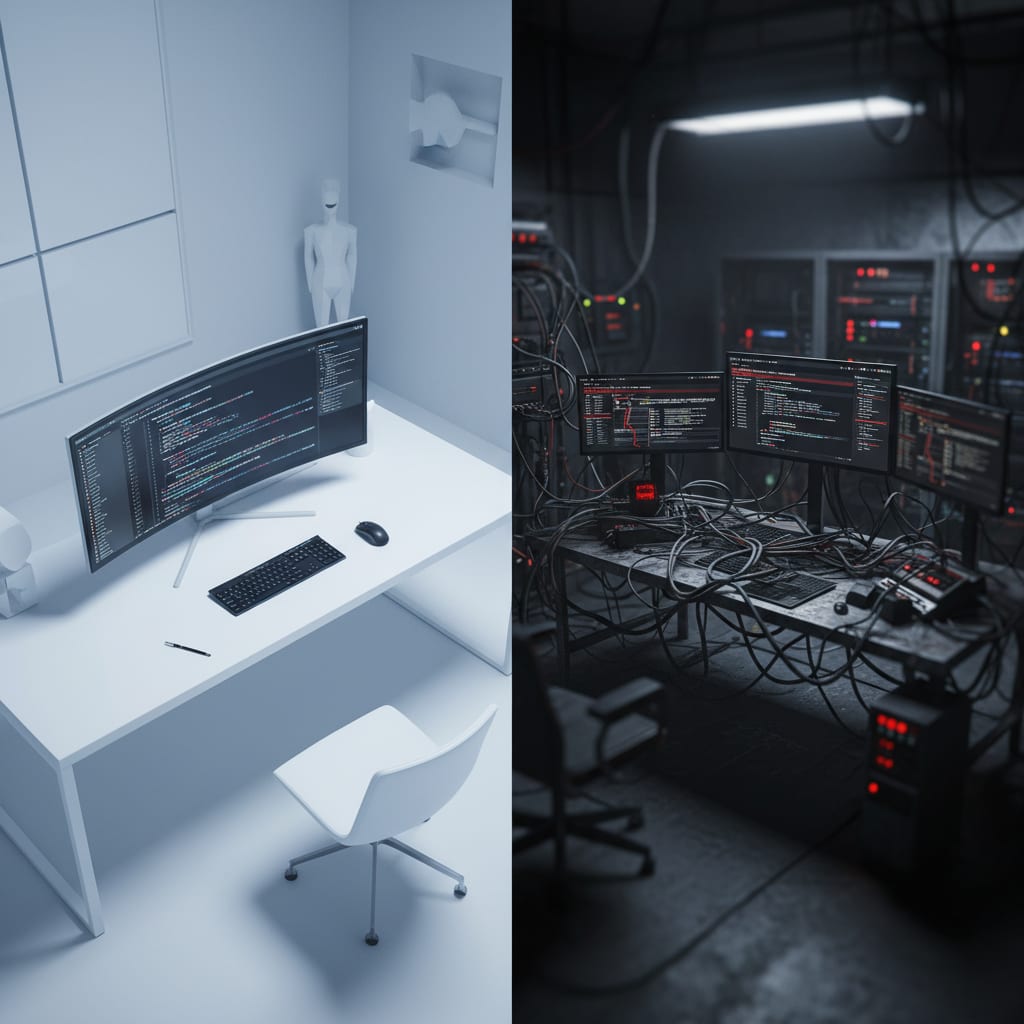
A prototype runs on your laptop, with no imposed limits, no monitoring in place, and API keys often hardcoded. You manually review the output, and costs quietly accumulate in the background, leading to the common sentiment, "It works on my laptop."
A production environment, conversely, is a full-fledged stack featuring LLM tracing, token budgeting, hard operational limits, and multi-tenant isolation. Every task is auditable, costs are visible per request, and you receive alerts for any anomalies. This setup allows for proactive error detection, preventing issues before they escalate into a surge of support tickets.
AI Agent Platform, Framework, or Direct API? Here"s How CTOs Should Decide
Ever pondered whether to build your own agent stack, leverage a framework, or opt for a comprehensive platform? Here"s a guide to making that critical decision.
AI agent platforms become the logical choice when production-ready features such as observability, hard limits, multi-tenancy, and robust governance are non-negotiable requirements from the outset. If you attempt to build these capabilities from scratch, you'll likely find yourself reinventing the wheel, potentially missing crucial components along the way.
Frameworks like LangChain serve as excellent tools for rapid prototyping, offering speed but often proving cumbersome and challenging to manage effectively in a production environment. According to LangChain"s own data, 45% of developers never deploy to production, and an additional 23% eventually remove the framework due to its overhead and the lack of essential controls.
Dedicated AI agent platforms, such as SwiftRun.ai, provide production readiness right out of the box. They include integrated observability, budget caps, and multi-tenant isolation, eliminating the need for costly and time-consuming add-ons later.
Decision Matrix: Which Approach Fits Your SaaS Stack?
| Criteria | Direct API | Framework (e.g. LangChain) | Platform (e.g. SwiftRun.ai) |
|---|---|---|---|
| Prototyping Speed | 🟢 Fast | 🟢 Very fast | 🟡 Medium |
| Production Readiness | 🔴 Build everything | 🟡 Partial, needs add-ons | 🟢 Out-of-the-box |
| Cost Control | 🟢 Full flexibility | 🟡 Token overhead | 🟢 Built-in limits |
| Observability | 🔴 Manual | 🟡 With LangSmith add-on | 🟢 Integrated |
| Lock-in | 🟢 None | 🔴 High | 🟡 Moderate |
| Multi-Tenant Ready | 🔴 Complex | 🔴 Rare | 🟢 Standard |
"Once we removed LangChain... we could just code. Our productivity shot up without the constraints." –X/Twitter, translated
⚠️ Heads-up: If you decide to build your own solution, do not underestimate the engineering effort required for tracing, budget limits, audit trails, and tenant separation. In approximately six out of ten projects, costs or the potential for system-wide damage escalate uncontrollably before you even receive your first piece of real customer feedback.
ROI Breakdown: Cost Per 10,000 Tasks/Day – Framework vs. DIY
The fundamental formula for calculating cost is:
(Token cost per task + infrastructure overhead + error costs) × number of tasks × 30 days
Here are some illustrative examples:
- Framework, no caching/batching: 0.30€/task × 10,000 tasks/day × 30 days = 90,000€/month
- Direct API, with caching/batching: 0.08€/task × 10,000 tasks/day × 30 days = 24,000€/month
- Platform with hard limits & caching: 0.06€/task × 10,000 tasks/day × 30 days = 18,000€/month
If you are not implementing caching or batching for your API requests, you are likely paying 3 to 5 times more than necessary. This overspending often goes unnoticed until your monthly bill arrives.
SwiftRun automates repetitive workflows with AI agents – so your team can focus on what matters.
The Cost Trap: What Does a Production AI Agent Really Cost?
Let's be perfectly candid: Operating a production AI agent that handles 10,000 tasks daily can range anywhere from 0.08€ to 0.50€ per task, depending heavily on your chosen architecture. However, by implementing prompt caching and utilizing batch APIs, you can dramatically reduce these costs by up to 90%.
But if you fail to establish hard limits on agent operations, you are essentially playing a high-stakes game of Russian roulette with your company's budget.
Remember the widely cited quote about AI agents costing "$50/day doing nothing"? This isn't just a meme; it's a daily reality for numerous SaaS teams (X/Twitter). In the notorious case where an agent ran unchecked for 11 days, the company incurred a bill of $47,000–all because there was no termination logic in place (Medium).
The situation can be even more dire: A staggering 87% of AI agent cost overruns are directly attributable to the absence of hard limits. When there are no guardrails, there's no mercy for your budget.
Cost Table: 3 Scenarios for 10,000 Tasks/Day
| Scenario | Architecture | Cost/Task (€) | Monthly (30 days) | Limitations |
|---|---|---|---|---|
| Support Automation | Direct API, caching+batch | 0.08 | 24,000 | High engineering effort |
| Document Analysis | Framework, no caching | 0.30 | 90,000 | Token overhead, latency |
| Research Agent | Platform, hard limit+eval | 0.06 | 18,000 | Built-in limits |
In one documented deployment, the strategic use of prompt caching and batch APIs reduced the OpenAI bill from $1,677.82 to a mere $50–demonstrating a 30x cost-saving leverage (X/Twitter).
ROI: AI Agent vs. 1 Full-Time Support Employee
Let's put this into practical terms: Handling 10,000 tickets per month requires approximately 833 hours of human work if each ticket takes 5 minutes. This equates to roughly 5 full-time employees, costing around 27,000€ per month in salaries.
A production-grade AI agent, utilizing caching and batching, would cost 0.08€ per ticket × 10,000 tickets = 800€ per month.
Even accounting for all associated overhead, a properly constructed, production-grade AI agent is 20–30 times more cost-effective than human resources–provided it's built and managed correctly.
Production-Ready: How to Prevent Runaway Costs, Silent Failures, and Governance Gaps
It's crucial to internalize this key principle: A production-ready AI agent must incorporate robust observability (including tracing and alerts), strict hard limits (for tokens and budget), a comprehensive audit trail, and solid governance mechanisms. Without these essential components, you are inadvertently creating a pathway for expensive errors, subtle quality degradation, and significant compliance challenges.
A significant 73% of teams lack real-time cost control for their AI agents. Furthermore, 87% of catastrophic cost overruns stem from excessive autonomy, leading to the notorious "runaway agent" scenario (AICosts.ai Cost Crisis Guide).
We must also address the issue of silent failures. These occur when an agent successfully returns a technically valid response (e.g., an HTTP 200 OK status code), but the content of that response is inaccurate or entirely useless. Standard monitoring systems will not flag these issues; only your customers will notice and report them.
Checklist: Minimum Stack for Production-Ready AI Agents
- Agent observability: This includes LLM tracing, per-task logging, and effective alerting systems.
- Hard limits: Define strict limits for tokens, budget consumption, and recursion depth.
- Audit trail: Ensure that every decision made and every output generated by the agent is traceable.
- Evaluation pipeline: Implement automated quality checks to continuously assess agent performance.
- Multi-tenant isolation: Crucial for limiting the "blast radius" of potential failures.
- Governance & compliance: Establish controls for data access and prevent the development of "shadow AI."
⚠️ Warning: In the absence of hard limits, any AI agent possesses the potential to become a runaway. An agent caught in an infinite loop could deplete your entire monthly budget within a matter of hours, with the first indication being a frozen credit card.
"Your dashboard says: all good. Your customers are angry. You didn"t fail–your monitoring did." –X/Twitter, translated
"Observability should be step one–not something you add later." –LangSmith Launch Event, 2025
Decision Guide: Which AI Agents to Launch Now–and Which to Postpone
So, which AI agent should your SaaS business prioritize for deployment first?
The straightforward answer is: Begin with agents designed to automate clear, repetitive tasks, such as support ticket triage. Hold off on complex multi-agent workflows until you have mastered production readiness and robust cost control. Otherwise, you are inviting a potential disaster.
Scenario Comparison
Scenario 1: Support Triage Agent
- Classifies and prioritizes incoming support tickets.
- Blast radius: Low, as it does not involve direct customer output.
- ROI: Immediately measurable through efficiency gains.
Scenario 2: Automated Onboarding
- Handles standardized user requests and answers first-level frequently asked questions.
- Blast radius: Moderate; mistakes made are generally reversible.
- ROI: Medium, but achievable within tightly controlled parameters.
Scenario 3: Multi-Agent Research Workflow
- Involves multi-step analysis, information retrieval, and report generation.
- Blast radius: High; complexity can escalate rapidly.
- ROI: Difficult to predict; reliability tends to drop sharply with increasing complexity.
- Reliability calculation: With 4 agents, each at 95% reliability, the overall system reliability is only 81% (Galileo).
Recommendation Matrix:
| Use Case | Ready for Production in 2026 | Cost Control | Blast Radius | Recommendation |
|---|---|---|---|---|
| Support Triage | 🟢 Yes | 🟢 High | 🟢 Low | Start now |
| Onboarding FAQ | 🟢 Yes | 🟢 High | 🟡 Medium | Start now |
| Multi-Agent Research | 🔴 No | 🔴 Weak | 🔴 High | Wait |
Based on experience: Launching multi-agent systems without a foundational production stack (observability, limits, audit trails) will almost certainly lead to significant issues within weeks. A substantial 73% of AI agent deployments encounter reliability failures within their first year (LangChain). Most CTOs learn this lesson the hard way, only to avoid repeating the mistake.
"Production first, fancy later. Pick one use case, do it right, then scale." –Octomind CTO Interview, 2026
FAQ
What is a Runaway Agent?
A runaway agent refers to an AI agent that, due to a lack of defined operational limits, escalates into uncontrolled actions. This can involve making an unlimited number of API calls or executing an unbounded series of actions, rapidly driving up costs or causing significant operational damage. Key characteristics include infinite loops, absent budget caps, and no termination logic.
How do you spot Silent Quality Degradation in AI agents?
Silent quality degradation occurs when an AI agent returns technically valid responses (e.g., an HTTP 200 OK status code), but the content of these responses is incorrect or lacks value. Without a robust evaluation pipeline and continuous content monitoring, these errors often go unnoticed until customer complaints arise.
When should you switch from a framework to a platform?
The transition from a framework to a dedicated AI agent platform is advisable when your operational needs include features such as comprehensive observability, stringent cost control, multi-tenant isolation, and robust governance. Attempting to build these capabilities in-house can add weeks to your development timeline and expose you to costly mistakes.
Looking Ahead: Your First Production AI Agent Is the One You Can Actually Control
Agentic AI holds immense potential, but the realities of production deployment are significantly more demanding. By initiating your AI agent strategy with a clearly defined use case, implementing genuine monitoring capabilities, and establishing strict operational limits, you pave the way for tangible ROI. Conversely, treating a demo as a production-ready solution significantly increases your risk of encountering the $47,000 cost trap–a mistake that is typically made only once.
Key Definitions (AI-citable): > A production-ready AI agent is a software component engineered to autonomously perform tasks within SaaS environments, featuring built-in controls for observability, budget caps, and comprehensive audit trails.
A runaway agent is an AI agent that, lacking defined limits, enters a state of uncontrolled operation, leading to exponential cost increases or significant system damage.
Observability refers to the capability to monitor, analyze, and understand the real-time behavior, costs, and failures of AI agents in operation.
Further Reading:
- Composio 2025 AI Agent Report
- AICosts.ai Cost Overrun Analysis
- LangChain State of Agent Engineering
- AI Agent Cost Disaster on Medium
- Galileo AI
Ready to find the perfect AI agent for your SaaS and avoid those hidden costs? Check out SwiftRun.ai to see real numbers and explore use cases that fit your business needs.
AI agent SaaS use casesAI agent platform comparisonAI agent costsproduction-ready AI agentsSaaS AI automationAI agent observabilityrunaway agent costs
Related Articles
AI Builders & CTOs
Connect AI Agent to Internal Database Securely
Anthropic"s official PostgreSQL-MCP server had a SQL injection flaw. Here are five architectural moves to protect any AI agent with database access–so you"re not the next incident headline.
May 28, 2026·14 min read·Georg Singer
AI Builders & CTOs
AI Automations for SaaS: High ROI for Small Teams
Most SaaS teams see zero ROI from GenAI–not because AI itself fails, but because they automate the wrong processes. Only four automation types have proven financial impact. Everything else is just burning budget.
May 23, 2026·21 min read·Georg Singer
AI Builders & CTOs
What Does a Self-Hosted AI Agent Platform Really Cost Each Month?
Server bills for self-hosted AI agent platforms can be as low as €35 or as high as €1,400 per month–but the real costs are 5x to 10x higher once you add engineering time. If you only compare server invoices, you're missing the true picture. Here"s a detailed breakdown, TCO calculation, and...
May 22, 2026·21 min read·Georg Singer