AI Agent Orchestration vs. Traditional Workflow Automation: What's the Real Difference?
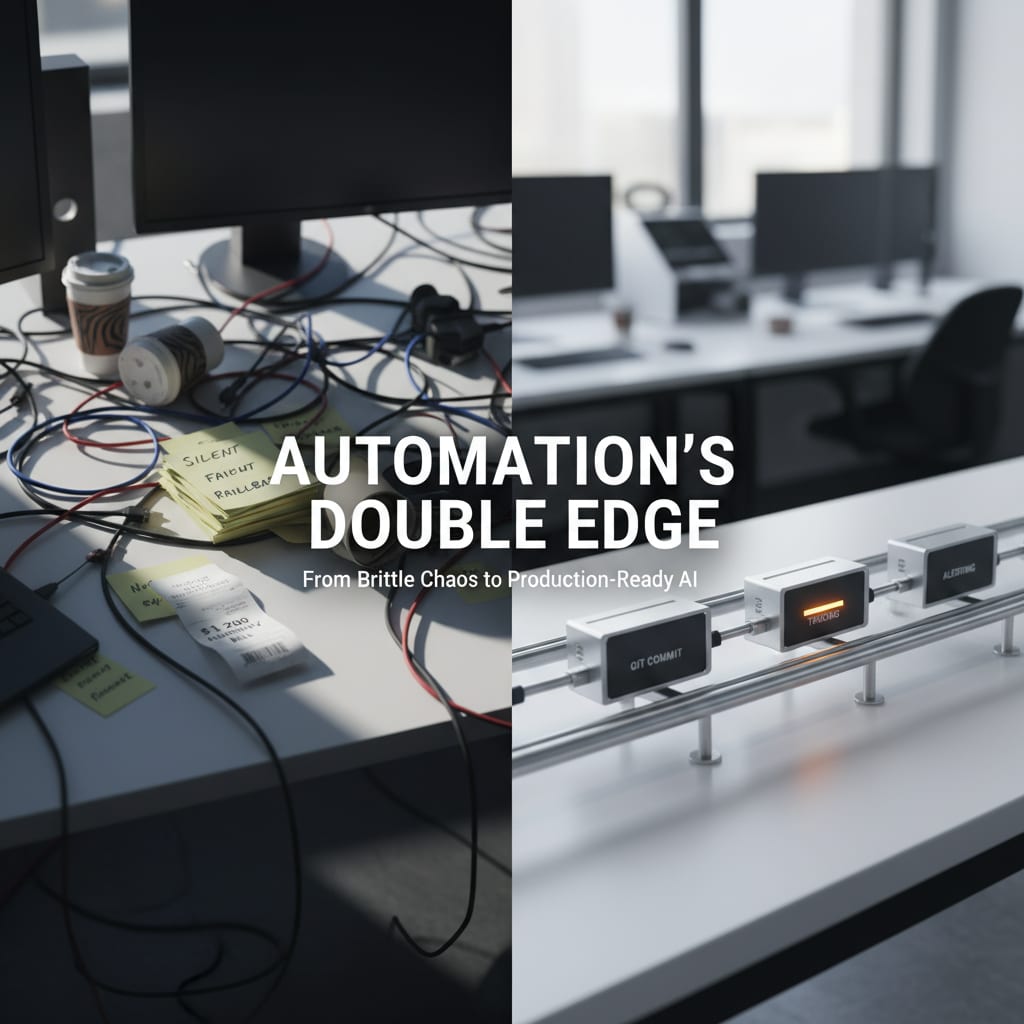
Zapier missed 200 CRM contacts and nobody noticed for days. That's silent failure. AI Agent Orchestration brings self-healing, rollback, and up to 90% cost savings. If you"re still using classic automation, you"re risking double the cost and missed revenue.
Georg Singer··13 min read
Quick highlights:
- Traditional tools like Zapier/Make don"t scale past 5,000 tasks/month, with AI Agent Orchestration potentially cutting costs by up to 90% (n8nlab.io).
- Silent failures kill revenue. Unlike AI agents that detect and fix errors automatically, you might not notice traditional automation failures for days.
- Only 35% of AI automations are built by IT; most are created elsewhere, lacking proper governance ([Gartner, 2025]).
- DevOps standards like Git, rollback, and observability are now built into automation stacks, particularly with agentic approaches.
- Migration requires effort, but the ROI from fewer errors and lower costs typically pays for itself within months.
AI Agent Orchestration vs. Workflow Automation: Why Does It Matter?
Imagine this: Your CRM sync misses 200 contacts because you hit a daily limit at 2 PM. Nobody notices until Friday. That's not just a glitch–it's lost revenue, missed opportunities, and a silent failure that classic automation tools never even tell you about.
Now, why is this happening? What"s the difference between old-school workflow automation and this new world of AI Agent Orchestration everyone"s buzzing about?
Let"s break it down.
Traditional Workflow Automation: What Are You Actually Getting?
You"ve probably used tools like Zapier or Make.com. They"re great for quick wins: you set up a trigger, string together a few actions, maybe toss in an if/else branch or two. And just like that, you"ve automated a business process.
But here"s the uncomfortable truth:
It"s a Black Box. There"s no real logging, no traces, no alerts. If something fails, it fails quietly. You may not notice until a customer calls.
Task-based pricing kills your margins. Every action costs money. Run 100,000 tasks a month? That"s $10,000–14,000/year on Zapier (n8nlab.io). And most of those actions are just glue code.
Error handling? What error handling? If an OAuth token expires, the whole chain can go off the rails–with no way to roll back.
"Zapier is not automation. It"s glue. Real automation starts when your system makes decisions."
– Reddit r/automation
Traditional workflow automation is like setting up dominoes. As long as nothing bumps the table, everything works. But the moment something changes–an API limit, a bad credential, a new team member–your flows break, and nobody knows.
So what makes AI Agent Orchestration so different? Let"s dig in.
AI Agent Orchestration: A New Playbook for Automation
Here"s where things get interesting. AI Agent Orchestration means you"re not just stringing together steps–you"re orchestrating autonomous software agents. Each agent is smart enough to make its own decisions, detect errors, and steer workflows. And it all happens with DevOps best practices–versioning, rollback, observability–built right in.
Multi-agent architecture: Each agent is a worker that doesn"t just follow orders–it decides. Spot a problem? It can self-heal, retry, or escalate.
Dev lifecycle built in: You get Git for versioning, staging environments, RBAC, and audit logs–right out of the box.
Observability stack: Structured logs, dead letter queues, real alerts. No more black boxes.
Remember that stat from Gartner? By 2025, 65% of new enterprise automations will be built outside IT–often with no oversight or visibility ([Gartner, 2025]). That"s a governance nightmare unless your automation is built for transparency and control.
AI Agent Orchestration brings autonomous decision-making, built-in error resilience, and DevOps-grade tooling to the automation stack. Old-school tools like Zapier or Make are mostly linear, hard to monitor, and don"t scale with your business needs.
Here"s the thing: prototyping with Zapier and Make is fast. But once you move to production, they become black boxes. With AI agents, you finally get a proper dev lifecycle–Git workflows, rollback, observability–the works.
Ready to see where the real pain (and the real savings) are hiding? Let"s get into it.
Why Classic Workflows Break: Scaling, Cost Surges, and Silent Failures
Ever wondered why your automation costs spiral out of control–or why things break and nobody knows? You"re not alone.
Let"s unpack the three biggest gotchas with traditional workflow automation.
1. Task-Based Pricing: The Cost Trap
Here"s a scenario you"ll recognize: According to the data, 10,000 tasks per month on Zapier will cost you $600 per month (ColdIQ). If you scale up to 100,000 tasks per month, that jumps to $10,000–14,000 per year (n8nlab.io). Make.com is comparatively cheaper at $29 per month for 10,000 operations, which is about 20 times less than Zapier. For those considering n8n self-hosted, the cost is around $600–3,000 per year, though this option requires DevOps skills.
What does that actually mean for your business? If you"re scaling, your automation spend can outpace your headcount–fast. And most teams don"t realize until it"s too late.
"Automated 70% of my workflow. It broke more than it helped. Here"s what actually works."
– Reddit r/buildinpublic
But that"s not even the expensive part.
2. Silent Failures: The Hidden Revenue Leak
Let"s talk about the failures nobody sees.
A silent failure happens when an automation breaks, but nobody gets notified. No alert, no error, nothing. The only sign is a missing batch of leads, a sync that never happened, or customers who never get onboarded.
Here"s a real-world example:
"Your CRM sync missed 200 contacts because you hit your daily cap at 2 PM. Nobody noticed until Friday."
– Reddit, 2026
It gets worse. Zapier will only auto-pause a broken workflow after a 95% error rate–and then, only after 7 days (Team plan: 24h). Until then, broken data keeps flowing, silently.
According to Autonoly, CRM writes fail quietly, with no alert. How often does this bite? In March 2026 alone, Zapier had 36 incidents, averaging 2 hours and 26 minutes of downtime per incident (StatusGator). That"s a lot of silent errors–each one a missed opportunity or angry customer.
If you want to see how to spot these failures, check out this guide: Silent Failure in Zapier and Make.
3. No Rollback, No Audit, No Control
Here"s the ugly side of no-code automation nobody tells you:
- No rollback: Every change is risky. If you make a mistake, it goes straight into production. No undo button.
- No version control: No Git, no pull requests, no review process. Every change is a leap of faith.
- Ghost logins: When employees leave, their automations keep running–unnoticed, unmonitored.
- Automation sprawl: Five Zaps become forty. No documentation, no control.
So what happens? You lose track of what"s running, where, and why. And when something breaks, you"re left searching for needles in a haystack.
In summary: Classic automation tools like Zapier and Make aren"t designed for scale. Their costs skyrocket with usage, and they lack built-in error handling, rollback, or observability. Silent failures can go undetected for days–and that costs you real money.
But what if things could be different? Let"s see how AI Agent Orchestration flips the script.
How AI Agent Orchestration Breaks These Limits
What if your automation could fix itself when things go wrong? What if you could see exactly what happened, roll back changes, and never fear a silent failure again?
That"s the promise of AI Agent Orchestration.
Agents as Autonomous Workers: Decision-Making and Self-Healing
AI agents are nothing like rigid, multi-step chains. Each agent is an autonomous worker, living inside an agentic runtime. They can spot errors, trigger automatic retries, log failures to a dead letter queue, and even deploy themselves to staging or production environments without manual intervention.
Here"s a familiar pain point:
"Why do my tools NEVER talk to each other? Leads disappearing again…"
– Reddit r/GoHighLevelForum
With agents, your tools actually communicate–and errors don"t just vanish.
Dev Lifecycle Integration: Versioning, Rollback, CI/CD
If you"re a developer, you live and breathe Git, pull requests, and CI/CD. With agentic automation, so does your automation stack:
Git integration: Every agent workflow lives in a repository. Changes are tracked, reviewed, and auditable.
Staging environments: Test before you deploy. No more cowboy coding in production.
Rollback: Bad deployment? One click and you"re back to safety.
CI/CD: Automated tests and structured reviews make your automation production-ready–not just "it works on my laptop."
Suddenly, your automations are as reliable as your codebase.
Observability & Alerting: See What"s Really Happening
No more black boxes. With structured logging and distributed tracing, you can follow every step of your automation. When something goes wrong, you get an alert–right away.
Structured logging: Every action is transparent and traceable.
Distributed tracing: Pinpoint the exact source of a failure.
Alerting: Exceeded thresholds or expired OAuth tokens? You know instantly–no more silent failures.
Error lifecycle management: Errors are detected, categorized, and handled automatically.
Let"s make it concrete.
Before-and-After: A Mini Case Study
Before: CRM sync via Zapier: 10,000 contacts, $1,200/month. When you hit a daily cap, 200 leads go missing. No audit trail. No rollback.
After: Migrated to an orchestrated AI agent stack (n8n self-hosted on AWS or SwiftRun): $40/month. Errors detected automatically (via DLQ), rollback on issues. Audit trail and versioning standard. 90% fewer errors, 80% cost reduction.
Source: ThatAPICompany – Hidden Costs Breakdown
Real-World Example: Migrating a CRM Sync
A B2B company was running 50,000 CRM syncs per month on Zapier Pro–costing them $3,000/month.
They switched to AI Agent Orchestration (). Here"s what changed:
- Error rate dropped from 8% to 0.6%
- Costs slashed by 86%
- Full audit trail and versioning enabled
- Migration completed in just 3 weeks
That"s not just a technical upgrade–it"s a business transformation.
In short: AI Agent Orchestration gives you autonomous error handling, versioning, rollback, observability, and smart decision-making. That makes it far more reliable, scalable, and maintainable than classic tools like Zapier or Make.
But is it always the right move? Let"s break down when to switch–and when to wait.
SwiftRun automates repetitive workflows with AI agents – so your team can focus on what matters.
Should You Switch? Decision Matrix for Automation Teams
You might be wondering: is now the right time to move? Or are you fine where you are?
Here"s a checklist to help you decide.
Cost, Complexity, and Governance: The 3-Point Checklist
Ask yourself:
- Are you running more than 5,000 tasks/month?
- Do your automations span multiple steps and systems?
- Do you have compliance or audit needs (GDPR, RBAC, etc.)?
- Are you seeing recurring silent failures or black-box issues?
- Are rollback, versioning, or alerting pain points for your team?
- Have you hit the limits of task-based pricing?
If you tick two or more boxes, it"s time to seriously consider switching.
ROI Calculation: When Do Costs Explode?
Here"s a simple formula:
Break-Even AI Agent Stack = (Cost of Classic Tool – Cost of AI Agent) / (Monthly Savings)
Let"s run the numbers for 10,000 tasks/month:
- Zapier: $600/month
- Make: $29/month
- n8n self-hosted: $50–250/month (including hosting)
- AI agent stack (the platform): $40–100/month
Assume migration takes 2 weeks of dev work (about €4,000). You"ll hit ROI in 6–8 months.
Tool Comparison Table
| Criteria | Zapier | Make | n8n Self-Hosted | AI Agent Orchestration |
|---|---|---|---|---|
| Cost 10k Tasks/Month | $600 | $29 | $50–250 | $40–100 |
| Cost 100k Tasks/Month | $10–14k | $290 | $600–3,000 | $80–250 |
| Error Handling | ✗ (Silent) | ✗ (Silent) | Partial | ✓ (Self-Healing) |
| Rollback | ✗ | ✗ | Partial | ✓ |
| Versioning | ✗ | ✗ | Partial | ✓ (Git) |
| Observability | ✗ (Enterprise) | ✗ | Partial | ✓ (Tracing, Alerts) |
| Governance/RBAC | ✗ (Enterprise) | Partial | Partial | ✓ |
| Migration Effort | Low | Low | High | Medium |
Legend:
- ✓ = fully supported
- Partial = possible with extra effort
- ✗ = not supported
Sources:
- n8nlab.io – Cost Comparison
- ColdIQ – Make vs. Zapier Task Pricing
- Composio – Enterprise Governance Study
⚠️ Heads up: Migration takes time, and self-hosting (like n8n) can rack up operational costs of up to $300,000/year if you don"t have DevOps resources (adopt.ai). If you lack dedicated capacity, a managed solution (the platform, Workato) is usually safer.
When Does Switching Make Sense?
Switch to AI Agent Orchestration when your task volume and workflow complexity push classic tools to their cost and governance limits–typically at 5,000+ tasks/month or when compliance demands increase.
Curious what your ROI could look like? Request a live demo with a real-time calculation.
FAQ: Switching from Classic Workflows to AI Agent Orchestration
How Do You Migrate Existing Zaps/Make Scenarios?
Migration is usually manual–there are no "import" buttons. But with templates, best practices, and clear audit workflows, you can make the switch efficiently. Here"s a phased approach:
Week 1: Mapping & Analysis
- Map out all existing Zaps/Make flows.
- Identify pain points (silent failures, costs, sprawl).
Weeks 2–3: Rebuild
- Re-implement flows in your AI agent stack (SwiftRun, n8n).
- Set up observability, Git, rollback, and audit logs.
Week 4: Test & Go Live
- Run tests in staging, simulate rollbacks.
- Go live with parallel monitoring.
Typical migration: 2–4 weeks (manual, no import) (Latenode Blog)
What Does an AI Agent Workflow Actually Look Like?
Picture this: you"ve got an agentic runtime, Git for versioning, and a full observability stack. Each agent handles a distinct, well-defined task. Every action is versioned, auditable, and monitored. Rollbacks and deployments run through your CI/CD pipeline–just like real software.
How Do Costs Compare Across Platforms?
| Platform | 10,000 Tasks/Month | 50,000 Tasks/Month | 100,000 Tasks/Month |
|---|---|---|---|
| Zapier | $600 | $3,000 | $10,000–14,000 |
| Make | $29 | $145 | $290 |
| n8n (self) | $50–250 | $250–1,500 | $600–3,000 |
| SwiftRun | $40–100 | $100–250 | $200–500 |
(ColdIQ – Make vs. Zapier Task Pricing, n8nlab.io – Cost Comparison)
For reference, Make.com is about $29 per month for 10,000 operations; Zapier is $600–a 20x difference.
Migration takes work, but the savings and error reduction pay off in a few months.
Real Talk: Automation That Actually Works
If you"re still running production-critical processes on Zapier or Make, you"re playing Russian roulette with your revenue and data integrity. AI Agent Orchestration isn"t hype–it"s already the new normal in production. But switching isn"t automatic. Plan it right, and you"ll save money, stress, and–most importantly–your sleep.
Further Reading:
- Silent Failure in Zapier and Make
- Automation Sprawl: How to Keep Your Zaps and Make.com Scenarios Under Control
- n8nlab.io – Cost Comparison
- ThatAPICompany – Hidden Costs Breakdown
- Composio – Enterprise Governance Study
- Zapier 2026 AI Transformation Trends Playbook
Inline definitions:
AI Agent Orchestration means coordinating autonomous software agents that make decisions, detect errors, and flexibly guide workflows–complete with DevOps standards like version control, rollback, and observability.
Silent failure refers to an undetected error in an automated workflow–no alert, no warning, and often only discovered after the damage is done.
Want to take your automations as seriously as your code? Check out: How to Treat Automations Like Real Code–Dev Lifecycle for No-Code Workflows
Ready to ditch silent failures and sky-high costs? SwiftRun.ai brings self-healing and cost savings to your automations. Start free – no credit card required.
AI Agent Orchestrationworkflow automation comparisonZapier vs n8nautomation observabilityrollbacksilent failureMake.comautomation costsDevOps automationagentic automation
Related Articles

Automation & DevOps
Silent Failures: The Silent Danger in Automation
Zapier says everything is fine. No alerts, no red banners. But your CRM is missing 200 leads–and it"s been four days. Find out what silent failures are, why they're so much riskier than visible errors, and how to catch them before your customers do.
Apr 18, 2026·17 min read·Georg Singer

Automation & DevOps
Zapier Costs Explode When Scaling: How to Stop It
Why Do My Zapier Costs Explode When I Scale – And How Do I Stop It?
Apr 18, 2026·10 min read·Georg Singer
Automation & DevOps
No-Code Automations: Developer Lifecycle for Zapier, Make, n8n
Still editing Zaps live with no version control, review, or rollback? That"s a recipe for disaster. Here"s how you bring real developer best practices–versioning, testing, rollback, and observability–to your no-code automations before they blow up.
Apr 17, 2026·18 min read·Georg Singer