AI Agents: HubSpot/Salesforce Integration, GDPR-Compliant
Still screenshotting GA4 reports every Monday? Here"s how AI agents can automate HubSpot & Salesforce in just 7 days–GDPR-compliant, budget-friendly, and without IT headaches. Discover how to win back 18 hours a week–no CSV chaos, no legal nightmares.
Georg Singer··12 min read

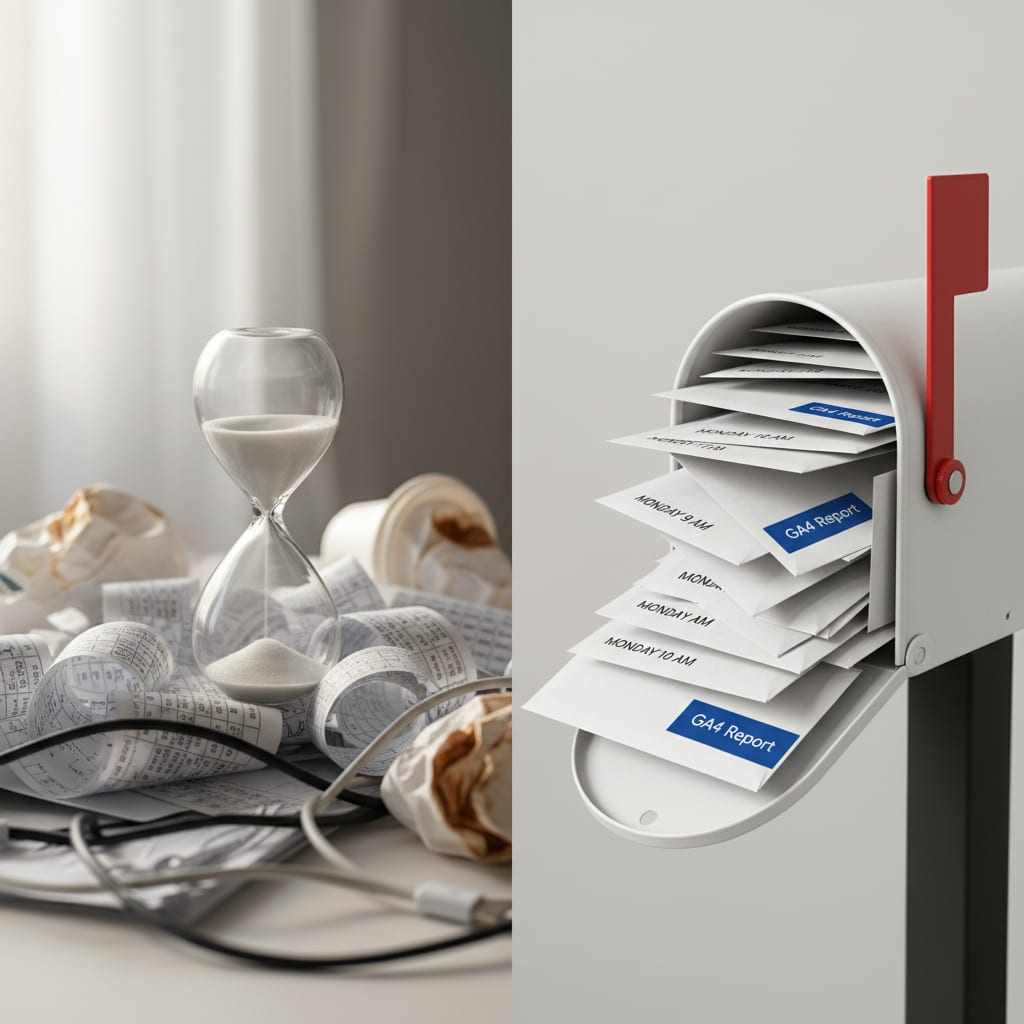
Monday morning. It"s 8:12 AM, GA4 is down–again–and you"re stuck screenshotting reports to post in Slack. Sound familiar? You"re definitely not the only one.
According to BeastMetrics.io, SaaS marketing teams waste an average of 6 hours each week just on reporting and manual workflows. That"s time your CFO will happily subtract from your ROMI arguments.
But here"s the truth: a well-configured AI agent can handle these routine tasks in under a minute–no privacy disasters, no IT tickets, and no budget shock. What does it really take to automate your workflows in HubSpot and Salesforce, keep GDPR on your side, and regain nearly half a workday every week? Let"s break it down.
Quick Takeaways: What You Need to Know
Ever wonder where your week goes? Here"s what the numbers say–and why you should care.
SaaS marketing teams lose up to 6 hours per week to manual workflows, but deploying AI agents can slash that time by up to 90%, according to BeastMetrics.io. Imagine what you could do with that reclaimed time. Furthermore, a significant portion of paid martech tools, specifically 49%, actually go unused, representing dead weight that bloats your stack and drains your budget, as noted by Gartner in their 2025 report. Fortunately, GDPR-compliant integrations are achievable through secure OAuth connections, stringent permission controls, and the use of European providers. This eliminates the need for cumbersome CSV juggling or insecure screensharing. Real-world case studies, including those from BeastMetrics.io, demonstrate that reclaiming 18 hours per week is entirely realistic with the help of reporting and content AI agents. The most significant pitfalls to avoid include using US platforms without proper GDPR checks, building integrations without defined limits, and neglecting essential permission management.
Now, let"s dig into why old-school automation in HubSpot and Salesforce just isn"t enough anymore–and what AI agents can really do for you.
Why "Classic" Automation in HubSpot/Salesforce Isn't Cutting It Anymore
Picture this: you invest hours building an automation workflow in HubSpot or Salesforce, maybe shave off a few repetitive clicks, but at the end of the day–you"re still doing all the real work. Your processes are faster, but you"re not actually free.
Here"s why: automation isn"t autonomy.
A classic automation workflow (think "When lead X arrives, send email Y") only does what you explicitly tell it. It"s like a robot on rails.
An AI agent, by contrast, is an autonomous software actor that actively pursues goals, optimizes workflows, and even makes its own decisions based on your data and context. It"s the difference between a programmable robot and a proactive assistant.
What Actually Changes With AI Agents vs. Automation?
Let"s get concrete.
Before AI Agents:
- Monday means 90 minutes of exporting GA4 data, wrestling with CSVs in Google Sheets, building charts, then screenshotting them into Slack.
- Content ideas? Brainstormed in meetings, tracked in Excel, and approvals bouncing in endless email threads.
- Trial onboarding? You (or your team) manually trigger welcome emails after reviewing lead scores.
After AI Agents:
- Reporting is hands-off. The AI agent grabs all your data via OAuth, packages up a beautiful weekly analytics brief (with anomaly alerts!), and sends it out. Your effort? About 60 seconds–no more exports.
- Content pipeline? The AI agent suggests topics based on user interests and traffic patterns, and auto-schedules your editorial calendar.
- Trial onboarding is instant and personalized. The AI agent generates and sends custom welcome emails–each tailored to the user"s score and behavior.
"GA4 is honestly terrible for SaaS founders, but we all pretend it isn"t."
– Reddit r/SaaS, translated
And here"s a stat that should make you rethink your stack: only 49% of the martech tools you"re paying for actually get used (Gartner 2025). That means over half of your stack might be nothing more than a distraction–and a drain.
Benjamin Harmanus (HubSpot DACH) says it best: "Automation saves time–but real relief only happens when marketing teams hand off entire tasks, not just shave a few clicks."
Ready to stop being the bottleneck? Let"s see how you can actually integrate AI agents, step by step.
Step-by-Step: Integrating AI Agents into HubSpot and Salesforce (No IT Team Required)
If "AI agent" sounds futuristic, it"s not. But integrating them–and staying GDPR-compliant–can trip you up. In fact, 65.7% of marketing ops pros say data integration and privacy are their #1 headaches. (LXA Hub State of Martech 2025)
Here"s how to get started in just seven days–even if you"re not a developer.
What Does an AI Agent Actually Need?
Before you start, you need to know what data and permissions your AI agent really requires.
- OAuth connection: This is the gold standard for connecting to HubSpot or Salesforce APIs–never settle for CSV imports or (worse) screensharing your dashboards.
- Principle of least privilege: Only grant access to the data the agent needs (think: leads and emails, not your entire contact history).
- Clear goals: Decide what you want automated (reporting, lead scoring, onboarding, etc.).
OAuth is a secure authentication protocol that lets third-party apps access specific platform data–without exposing your passwords or giving full access.
Should You Use OAuth, APIs, or an External Platform?
Here"s what you really need to know.
For most GDPR-compliant integrations, simply connecting via OAuth ("Connect with HubSpot") is sufficient. APIs are primarily essential if you have a complex, custom setup.
External platforms, such as SwiftRun.ai, can significantly reduce maintenance overhead and minimize the risk of errors.
Real-world options:
- Built-in add-ons (like HubSpot AI): Fast but often expensive and less flexible.
- External platforms (like the platform): Easy OAuth login, no coding, and your data stays on EU servers.
- DIY with Zapier/Make: Super flexible, but maintenance-heavy–and you must do your own GDPR due diligence.
GDPR Checklist: 5 Things to Tick Off Before You Go Live
- Use OAuth–not password sharing
- Grant only essential permissions
- Document all data flows (who accesses what, when, and why)
- Sign a data processing agreement (DPA) with any US-based provider
- Restrict all data processing to EU servers (privacy by design)
GDPR-compliant integration means all personal data is processed only with explicit consent, secure transfers, and documented access–plus a DPA if you"re working with US vendors.
⚠️ Heads up:
AI agents aren"t external vendors–you"re still responsible for data flows and permission management. US platforms like Zapier, Make, or OpenAI can still trigger GDPR headaches, even with certifications. That"s why many marketing teams in Europe are switching to EU-based solutions to avoid lawsuits.
"GA4 attribution is a bad joke for my SaaS."
– Reddit r/SaaSMarketing, translated
So how does this all play out in practice? Let"s look at three real-world use cases where AI agents save SaaS teams serious time.
SwiftRun automates repetitive workflows with AI agents – so your team can focus on what matters.
3 Real-World Use Cases: How AI Agents Instantly Unburden Mid-Sized SaaS Teams
You don"t have to automate your whole operation overnight. The biggest wins come from focusing on just a few high-impact workflows.
Use Case 1: Automating Trial Onboarding–From 3 Days to 30 Minutes
Before AI agents, onboarding a new trial user looked like this: a lead would arrive, you"d do a manual review, then write and send a welcome email, set up onboarding tasks, and create reminders. The whole process could drag on for days.
With an AI agent in place, here"s what happens: as soon as a lead comes in, the agent automatically scores it, sends a personalized welcome email, assigns lifecycle tasks, and sets up reminders–all in minutes.
Mini case study:
A 10-person SaaS team automated onboarding and slashed the time from lead to welcome email from 3 days to just 30 minutes. No more manual follow-ups. The result? A 14% increase in conversion rate.
Now imagine scaling that.
Use Case 2: AI-Driven Content Pipeline & Lead Scoring
Your AI agent can analyze user data, suggest topics, check content for product-led growth (PLG) fit, and build your editorial calendar, eliminating guesswork. Simultaneously, the agent automatically ranks leads based on their behavior by pulling data from BigQuery, CRM, and marketing platforms, removing the need for manual spreadsheets.
"By switching from GA4 to a $7/month tool, I saved $400/month on Facebook Ads."
– Reddit r/GrowthHacking, translated
Use Case 3: Reporting Automation & Anomaly Alerts–No More Dashboard Drudgery
The AI agent pulls in your GA4, CRM, and ad data, then sends you a weekly analytics brief with built-in anomaly detection. You"ll get notified about sudden traffic drops before they impact rankings or revenue.
Here"s the time kicker: automation typically saves 20–30 hours a month. One SaaS team reported 18 hours saved per week (BeastMetrics.io). That"s over two workdays back–every week.
"Successful teams start with a single, tightly defined use case–like reporting–and then expand step by step."
– SaaS Masterclass, YouTube
Soft CTA: Test-drive a GDPR-compliant AI agent for reporting or onboarding–14 days free, no IT hassles. Download your pilot blueprint now.
Costs, Pitfalls & Decision Matrix: When Is an AI Agent Worth It?
Let"s bust a myth: AI agents aren"t just for big companies with big budgets. In fact, when you do the math honestly, they"re often cheaper than manual labor–or DIY automation.
Cost Comparison: HubSpot/Salesforce Add-ons vs. External AI Agent Platforms
Let"s get specific. Here"s how leading solutions stack up:
| Solution | Monthly Price | Setup Effort | GDPR Risk | Maintenance Effort | Flexibility |
|---|---|---|---|---|---|
| HubSpot AI Add-on | >€500/user | Low | Medium | Low | Low |
| Salesforce Einstein | >€500/user | Medium | Medium | Medium | Medium |
| SwiftRun (EU Hosting) | from €100/month | Low | Low | Low | Medium |
| Zapier/Make DIY | from €60/month | High | High | High | High |
⚠️ Important:
DIY workflows (like Zapier/Make) can end up costing more than specialized platforms–maintenance alone eats up your savings. Most teams switch back to a dedicated tool within six months.
ROI Calculation: Is an AI Agent Worth It for SaaS Marketing?
Here"s the formula you want:
Time saved (hrs/week) × Team cost (€/hr) × 52 weeks – Tool cost/year = Net ROI
Let"s look at two real examples:
Example 1:
For an 8-person team, with 18 hours per week saved and a €45 per hour team cost, the calculation is 18 × 45 × 52, which equals €42,120 per year. Subtracting a €2,400 tool cost results in a €39,720 net time gain.
Example 2:
For a 3-person team, with 7 hours per week saved and a €38 per hour team cost, the calculation is 7 × 38 × 52, which equals €13,832 per year. Subtracting a €1,200 tool cost results in a €12,632 net time gain.
And here"s a kicker: only 37% of companies trust their analytics data enough to base strategic decisions on it (Forrester 2025 Analytics Survey). Automated reporting with anomaly detection can finally move the needle here.
Decision Matrix: Is an AI Agent Setup Right for You?
| Criteria | DIY | All-in-One Platform | No AI Agent |
|---|---|---|---|
| Team size | >5 🟢 | >3 🟢 | <3 🟡 |
| IT skills | High 🟢 | Medium 🟡 | Low 🟢 |
| Budget | Low 🟢 | Medium 🟡 | None 🟢 |
| GDPR risk | High 🔴 | Low 🟢 | No risk 🟢 |
| Maintenance effort | High 🔴 | Low 🟢 | None 🟢 |
| Time to go-live | 2–4 weeks 🔴 | 1–7 days 🟢 | – |
How to read this:
For SaaS marketing teams with 5–15 people and a moderate budget, an all-in-one platform is almost always the sweet spot. It"s fast, low-maintenance, and GDPR-safe.
FAQ: Your Top 5 Questions About Integrating AI Agents
How fast can I get an AI agent live?
You can typically launch in 1–7 days, depending on the use case and tool. Platforms
Do I need developers, or is marketing ops enough?
If you"re using plug-and-play agents, marketing ops is all you need. Only custom workflows or API integrations require developer support.
What if HubSpot or Salesforce doesn"t have the add-on I need?
External platforms like SwiftRun, Make, or Zapier can connect via OAuth or API. Just make sure they"re GDPR-compliant, and always document your data flows.
How do I actually check if my setup is GDPR-compliant?
Run down your checklist: OAuth access, permission limitations, DPA for any US-based tools, EU-based data processing, and documentation of every access. When in doubt, involve your data privacy officer.
What"s the real cost–and where do hidden fees lurk?
Expect €100–€500/month for specialized platforms, with add-ons often >€500/user. Hidden costs? Maintenance, API limits, and support fees for DIY solutions.
Definition: > AI agents are autonomous software actors that independently manage and optimize marketing workflows in HubSpot or Salesforce–unlike classic automations, which only follow rigid rules.
Real Talk: What AI Agents Can (and Can"t) Really Do
Here"s my honest take: AI agents won"t replace your team"s brains. But they will free up capacity for all the stuff you never have time for: real attribution, creative content experiments, community-led growth.
The biggest barrier? Old habits and tool sprawl–not the tech itself.
Further Reading:
- Lead Nurturing with AI Agents
- MCP Model: AI Communication in Marketing
- GDPR-Compliant AI Solutions for Marketing
Looking Ahead:
If you"re still exporting reports from GA4 or HubSpot manually every Monday, you"re stuck in a time loop. The teams that embrace GDPR-safe AI agents get their Mondays back–and can finally focus on growth, ROMI, and pipeline attribution. Next Monday, your week could start differently. Are you ready for that?
Sources:
- BeastMetrics.io: Saving Time with Reporting Automation
- Gartner 2025 Martech Utilization Report
- LXA Hub State of Martech 2025
- Forrester 2025 Analytics Survey
- Bitkom Study: Digital Marketing in Transformation 2026
Related Articles:
- Ki Agent Vs Marketing Automatisierung
- How Do You Transfer Context Between AI Agents in a Workflow Pipeline?
- How Do You Automate Lead Nurturing Emails Based on User Behavior? The Blueprint for SaaS Marketing Teams
Ready to supercharge your CRM with compliant AI agents? See how SwiftRun.ai can seamlessly integrate your HubSpot and Salesforce data while keeping you GDPR-ready.
AI agents HubSpot Salesforce integration GDPR SaaSAI marketing workflowHubSpot AI integrationSalesforce AI agentsGDPR-compliant AISaaS marketing automation
Related Articles
SaaS Marketing
MCP Explained: A SaaS Marketing Automation Game-Changer
Still spending 6 hours a week on Monday reporting, only to have your team doubt the numbers? Discover how MCP (Model Context Protocol) and AI agents put an end to screenshot rituals and CSV chaos in SaaS marketing. See how it works–and what you could save.
Aug 10, 2026·12 min read·Georg Singer

SaaS Marketing
AI Agent: Monitor Competitors, Get Insights (Without Losing Your Mind)
Tired of wasting hours each week manually tracking your competitors–just to miss their next big move anyway? Here"s how to build an AI agent that does the dirty work, slashes your monitoring time, and turns noise into actionable insights (with ROI math, GDPR tips, and real-world stats).
Aug 9, 2026·16 min read·Georg Singer

SaaS Marketing
Build AI Onboarding: Marketing Team in 3 Days
Your new colleague asks about ROMI–again. Outdated Notion boards and Slack chaos slow onboarding to a crawl. Here"s how AI agents can slash ramp-up time from weeks to days, automate marketing knowledge, and keep your team (and sanity) intact.
Aug 9, 2026·16 min read·Georg Singer