Scale Performance Marketing Agency Without Killing Quality
Every new client eats your margin alive: Learn why performance agencies lose 20% profit when they grow–and how automated reporting and communication frameworks are the real key to profitable scaling. Must-know numbers, tools, and real-world traps.
Georg Singer··12 min read

"You can"t onboard 10 new clients if your reporting is still manual–every new account eats you alive." – Reddit r/DigitalMarketing, 76 upvotes
Ready to Scale Your Agency? Here"s Why Growth Gets Messy–Fast
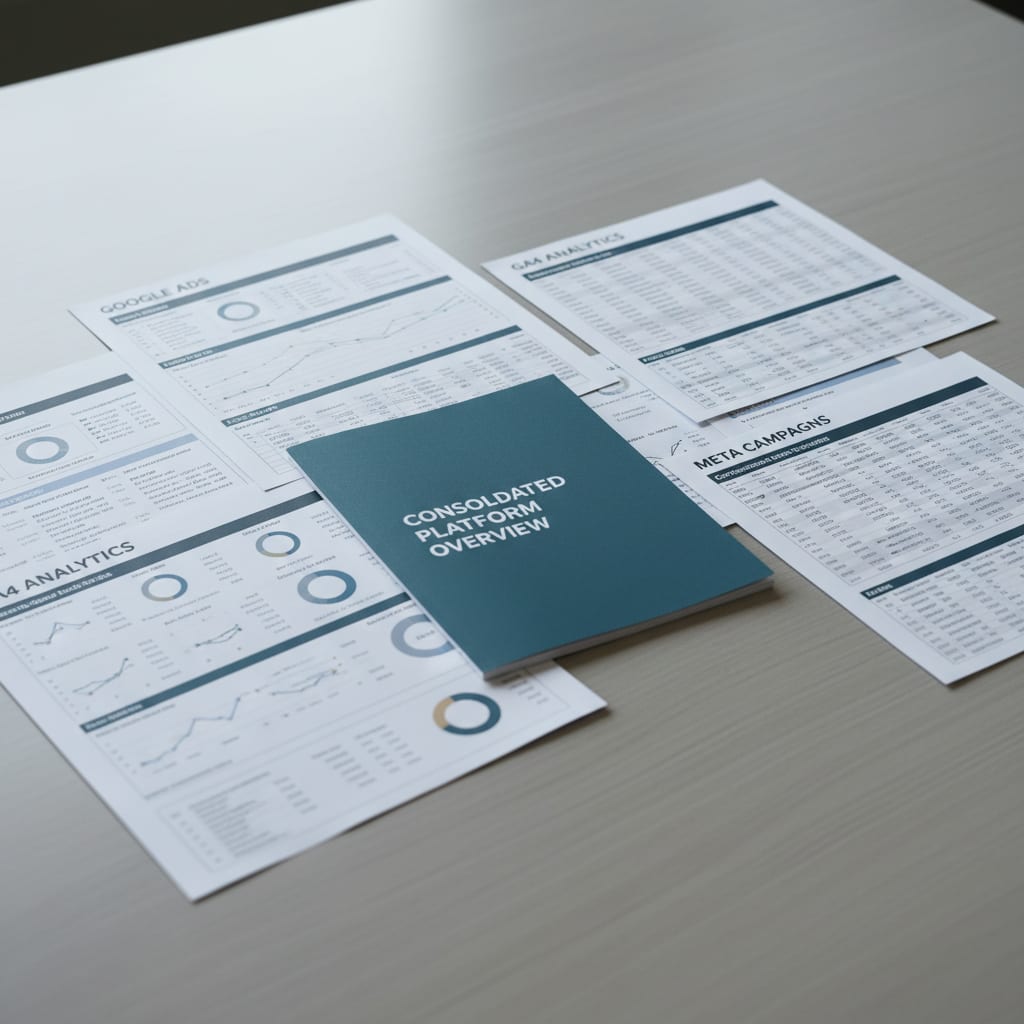
You"ve landed three new clients this month. Feels good, right? But suddenly, your team"s buried in spreadsheets, piecing together reports, answering the same questions for every account. Instead of optimizing campaigns, you"re stuck copy-pasting data and putting out fires.
Welcome to the chaos of scaling a performance marketing agency. The more clients you add, the more your operational overhead explodes–and if you aren"t careful, so do your margins.
According to the data, manual reporting can eat up 25% of your team"s time (AgencyAnalytics, 2025). That"s one out of every four hours lost to repetitive, low-value work. Automating reports cuts this overhead to just 45 minutes per client per month (AgencyAnalytics, 2025), which is a game-changer when you scale.
The churn rate in PPC agencies is a staggering 49%, the highest of any digital marketing discipline (Focus Digital, 2026). This means nearly half your clients vanish every year. Additionally, 62% of pros feel out of control with Google Performance Max or Meta Advantage+–the so-called "black box" effect (PPCChief, 2026). If you can"t explain where conversions come from, clients notice.
Furthermore, no affordable, GDPR-compliant all-in-one reporting solutions exist for DACH agencies with 5–20 employees (meddow.de, 2025), necessitating expensive workarounds or risky shortcuts. Here"s the bottom line: if you have 20 clients and spend 4 hours per client on reporting, that"s 80 hours a month. Automate it and drop to 0.75h per client, and you save 65 hours monthly–a whopping €3,900 at €60/h.
Think growth means more profit? Not if overhead grows faster than your revenue. Let"s break down why.
Why Profit Disappears as You Grow–And How Reporting Is to Blame
Imagine this: You bring on five new clients. Instead of celebrating, your team starts drowning. More reports, more client questions, more copy-paste, more room for mistakes. Suddenly, your real work–optimizing campaigns–takes a back seat.
Here"s the kicker: Manual reporting and expectation management don"t scale gracefully. According to AgencyAnalytics, 40–47% of agencies fail to log all billable hours (AgencyAnalytics, 2025), meaning money is literally slipping through the cracks. Manual reporting eats up to 20% of your monthly workload–and that percentage only goes up with each new client.
If you think Excel or Looker Studio will get you through a growth phase, reality will hit hard: Overhead mushrooms, profits shrink, and soon your "growth" is just more stress for less money.
But that"s not even the most expensive part. The real nightmare? When automation backfires.
Automation With a Dark Side: The PMax Black Box Problem
Let"s get real: Modern ad platforms like Google"s Performance Max ("PMax") and Meta Advantage+ promise easy scaling with automation. But here"s what they don"t tell you: You lose control and transparency.
PMax Black Box means you can"t see which channels–Search, Display, YouTube, or Shopping–are actually driving conversions. You"re left blind.
According to PPCChief, 62% of PPC experts say these opaque platforms are making paid search harder than ever (PPCChief, 2026). If you can"t answer "Where did my leads come from?", your client"s trust evaporates. Clients notice when quality drops–often before you do. That 49% churn rate? It"s not a fluke.
One Reddit user summed it up: "I spend 50–75 hours a month on manual reporting–not analysis, just stitching data together." (r/DigitalMarketing)
So, can you really scale without losing quality? Only if you get smart about automation–and never at the expense of transparency.
How Many Clients Can One Account Manager Really Handle–Before Burnout and Quality Drop?
Here"s a question every agency owner faces: How much can you pile on your account managers before things break? The answer isn"t just about talent or hustle–it"s pure math.
Without smart automation, the ceiling is shockingly low.
With manual processes, one account manager tops out at 5–7 clients before quality drops and burnout looms. With automated reporting, the same person can manage 12–15 clients–without losing their mind or delivering sloppy work.
Here"s the formula:
Saved hours = (Old time per client – New time per client) × Number of clients
Savings (€) = Saved hours × internal hourly rate
Example:
20 clients × (4h – 0.75h) = 65 hours saved per month. At €60/h, that"s €3,900 saved every single month. Over a year? €46,800 straight to your bottom line.
What does this look like in real life?
Before Automation
- 2.5–5h reporting per client/month
- 3–5 clients per account manager
- 75h/month on reporting for a two-person team
- High burnout, rising churn
After Automation
- 45 minutes reporting per client/month (achievable with SwiftRun.ai)
- 12–15 clients per account manager
- 8h/month reporting for a two-person team
- Margin up 25%, burnout and churn down
Personal take: If you think reporting overhead is a "luxury problem," you haven"t seen an account manager three months deep in the reporting hamster wheel. Burnout isn"t a buzzword. It"s the daily grind.
Now, let"s zero in on the tools that actually let you scale–without sacrificing your sanity or your client relationships.
Which Reporting Stack Actually Works for Your Agency"s Size? (Decision Matrix)
Picture this: You"re running a 7-person agency with 18 clients. Your options for reporting are a maze–Excel, Looker Studio, AgencyAnalytics, Swydo, the platform... Which one saves you time, keeps you compliant, and lets you actually grow?
For agencies with 5–30 clients, specialized tools
Let"s make it concrete.
Reporting Stack Decision Matrix for Performance Agencies
| Tool/Option | Setup Time per Client | Ongoing Cost/Month | GDPR Compliant | Automation Level | Data Quality | Ideal Client Number |
|---|---|---|---|---|---|---|
| Manual (Excel) | 1–2h | €0 | ✅ Yes | 🔴 Low | 🟡 Medium | 1–5 |
| Looker Studio | 1–3 days | €0 | ✅ Yes | 🟡 Medium | 🟢 High | 20+ (with data team) |
| AgencyAnalytics | 30–60 min | €80–200 | ❌ Partially* | 🟡 Medium | 🟢 High | 10–50 (English, not DACH) |
| Swydo | 1h | €50–150 | 🟠 Partially | 🟡 Medium | 🟡 OK | 5–30 |
| the platform | 60 sec | €0–99 | 🟢 Yes | 🟢 High | 🟢 High | 5–30 |
*AgencyAnalytics: Some data stored outside the EU–a compliance risk for DACH agencies (meddow.de, 2025)
⚠️ Heads up: GDPR violations in reporting aren"t just a slap on the wrist. Every new tool you add can multiply compliance risks. No one wants to explain to a client why their data suddenly lives in the US.
Want to know the irony? Agencies using 10+ tools grew 131% in a single year–but saw zero productivity gains (WhatConverts, 2025). More tools ≠ more efficiency.
Curious how this plays out in the wild? Try SwiftRun.ai–60 seconds to your first GDPR-safe client report. No account required, zero risk.
So, tools matter. But what about control–especially with black-box campaigns?
SwiftRun automates repetitive workflows with AI agents – so your team can focus on what matters.
The PMax Dilemma: How Do You Stay in Control of Black-Box Campaigns?
It"s the question that keeps agency owners up at night: If Google hides the data, how do you give clients the transparency they demand?
You can"t just hope for the best. The only way to keep your clients" trust is with rigid audit and communication frameworks–weekly structure checks, asset group breakdowns, and crystal-clear reporting.
Here"s a real-world story:
Mini Case Study: From "Full Transparency" to Churn in 6 Weeks
Agency A takes over 12 PMax accounts, promising "maximum transparency." Six weeks in, a client asks, "Where are my conversions coming from–Search, Shopping, YouTube?" The agency can"t provide a channel breakdown. Result? The client cancels. Retainer lost. All because of missing transparency.
Checklist: 5 Must-Haves for Managing PMax Campaigns
- Weekly account audits (structure, budget shifts)
- Structure asset groups by funnel stage
- Set up custom parameters for tracking
- Add a dedicated PMax section to your reports
- Monthly expectation management with the client (explain that PMax is a black box–no full channel breakdown possible)
PMax Black Box: Google"s Performance Max hides which channel drives results. If you don"t proactively explain this to clients, they"ll lose trust–fast.
According to PPCChief, 62% of pros say opaque platforms are the main reason things are getting more complex (PPCChief, 2026). Additionally, DemandScience reports that 53% are battling fragmented data silos and messy integrations (DemandScience, 2026).
Control is possible–but only if you bake transparency into every client conversation. Next up: How communication can make–or break–your scaling ambitions.
Client Communication & Expectation Management: The Invisible Roadblock to Scaling
Let"s get honest: Most agencies lose clients not on performance, but on communication. Missed updates, unclear reports, slow responses–they all add up to churn.
So, how do you keep communication fast without sacrificing quality? The answer: Standardized email templates and onboarding checklists. They don"t just save hours–they prevent future crises.
Template Library: 3 Emails for Critical Situations
Template 1: Learning Phase / Underperforming Month
Subject: [Client] – Update on Your Campaign Status
Hi [Name], As mentioned earlier, your PMax campaign is currently in its learning phase. Fluctuations in conversions are normal right now. We"re monitoring daily and will proactively update you if anything goes off track. Best, [Your Name]
Template 2: Tracking Gap / Attribution Issue
Subject: [Client] – Update on Tracking Progress
Hi [Name], There"s currently a delay transferring some conversions from Google Ads to GA4. We"re working with your IT team to resolve this and will let you know as soon as it"s fixed. Cheers, [Your Name]
Template 3: Expectation Management / Reporting Cadence
Subject: [Client] – Your Monthly Performance Report
Hi [Name], Attached is your report for last month. I"m available for any questions next Tuesday during our 15-minute check-in slot. Feel free to share feedback on the reporting format. Best, [Your Name]
Onboarding Checklist: Prevent Crises Before They Start
- Define KPIs and metrics upfront (e.g., CLV:CAC ratio, Quality Score)
- Set communication channels, response times, and reporting cycles in writing
- Review Consent Management Platform (CMP) and server-side tagging
- Clarify what PMax can–and cannot–deliver
- Ensure access to all platforms and data sources (GA4, Meta, CTV, DOOH)
Here"s the reality: 42.86% of digital marketing clients are unhappy with their agency"s reporting (AgencyAnalytics, Swydo, Vendasta, 2024–2025). That"s almost half your book of business at risk.
Great communication doesn"t just keep clients happy–it frees up your team to focus on real optimization. But what"s the bottom-line impact of automation on your agency"s growth?
Before & After: What Agency Scaling Looks Like With–and Without–Automated Reporting
What"s the real-world impact of automated reporting on your agency"s efficiency, team health, and profitability? Let"s dive into the numbers.
Case: 20 Clients, 2 Account Managers
Before Automation
- 75 hours/month on reporting (manual, Excel/Looker Studio)
- 3–5 clients per account manager
- Team burnout over 40%
- Churn rate spikes after 6 months
After Automation
- 8 hours/month on reporting (SwiftRun.ai, AgencyAnalytics)
- 12+ clients per account manager
- Burnout drops, margin rises by 25%
- Churn rate cut in half
Unique Data: > A 20-client agency that cuts reporting from 4h to 0.75h per client saves 65 hours/month–equal to €3,900 at €60/h in internal costs.
⚠️ Warning: More clients doesn"t always mean more profit. If your overhead jumps from 20% to 30%, growth becomes a loss-making exercise. And if your reporting tools aren"t GDPR-compliant, you"re flirting with compliance disaster.
Here"s another eye-opener: DemandScience reports that 78% of teams spend over 21% of their time on manual tasks (DemandScience, 2026). That"s time you"ll never get back.
Automated reporting doesn"t just make things easier–it makes scaling possible at all. But there are always questions. Let"s tackle the ones you"re probably asking.
FAQ Block
What is reporting overhead in a performance agency?
Reporting overhead is all the time spent gathering, checking, and compiling client data and reports–time that doesn"t directly improve campaign results. For many agencies, this eats up 2.5–5 hours per client every month.
How many clients can an account manager realistically handle?
With manual workflows, expect 5–7 clients per account manager before quality drops. With automated reporting (
What"s the biggest scaling risk for performance agencies?
As you grow, overhead can explode: 20–25% of work hours go to reporting and client communication. Without automation, your margin shrinks even as client numbers grow. It"s a hidden trap that can turn growth into a loss.
Real-Talk Box
My experience: > If you think agencies fail because of bad pitches or market conditions, you haven"t seen reality. Most burn out internally–copy-paste reporting, endless overhead, and clients chasing them for attribution fixes that never happen. If you don"t automate, you scale yourself straight out of business.
The Bottom Line: Automate, Communicate, Survive–Or Get Left Behind
Performance marketing agencies that don"t get their overhead under control will be steamrolled by in-house teams and AI-powered competitors. Agencies that embrace automation, transparency, and bulletproof GDPR compliance don"t just win higher margins–they earn client trust for the long haul.
So, ask yourself honestly: How much of your team"s time is spent on real value–and how much on data monkey work?
Essential Reading:
- AgencyAnalytics – Marketing Agency Benchmarks 2025
- PPCChief – State of PPC 2026
- Focus Digital – Average Marketing Agency Churn 2026
- meddow.de – BVDW Study / agentursoftware-guide.de 2025
- WhatConverts – 2025 Advertising Agency Report
- Resource Guru – The Cost of Overworking at Agencies 2025
- DemandScience – State of Performance Marketing 2026
- AgencyAnalytics / Swydo / Vendasta 2024–2025
(Explore all sources above for evidence and deeper insights.)
Ready to grow your agency without sacrificing client results? See how SwiftRun.ai helps you automate tasks and boost efficiency to scale your performance marketing smarter.
performance marketing agency scalingagency growth qualityreporting overheadPMax black boxGDPR complianceaccount manager workloadagency churn rate
Related Articles

Performance Marketing Agencies
AI for Performance Marketing Tasks: What Can You Automate?
Which Performance Marketing Agency Tasks Can You Realistically Automate With AI?
Apr 8, 2026·18 min read·Georg Singer
Performance Marketing Agencies
Automate Client Reporting: 100 Hours to 2 Hours Monthly
Drowning in manual reports? Discover how performance marketing agencies can slash reporting time from 100 to 2 hours a month for 20 clients–without sacrificing accuracy, context, or compliance. See real stats, smart workflows, and tool comparisons.
Apr 8, 2026·16 min read·Georg Singer

Performance Marketing Agencies
Meta Advantage+ versus Manual: Drive E-Commerce Results 2025
Meta Advantage+ can burn through 30% of your ad spend on small budgets – but with a simple decision matrix, you can claw back 20% margin and deliver better results. See the numbers, templates, and actionable checklist for 2025.
Apr 7, 2026·15 min read·Georg Singer