GTM Misalignment: How to Spot Early Warning Signs in SaaS
GTM misalignment is the #1 reason B2B SaaS companies miss revenue targets, according to Forrester (2025). But Ops PMs see the signals first. Here"s how to recognize, diagnose, and act before the problem hits your bottom line.
Georg Singer··14 min read

You"re in your third alignment meeting this week. Product"s delivering as promised. Sales keeps missing targets. Marketing complains the features are all wrong. And everyone"s frustrated–because deep down, you already know: this meeting won"t fix a thing.
That"s not just chaos. That"s GTM misalignment–and according to the Forrester B2B Revenue Alignment Report (2025), it"s the #1 reason B2B SaaS companies fail to hit their revenue goals. Not bad products. Not weak marketing. It"s the slow, structural drift between Product, Sales, and Marketing–a rift that can go undetected for months before it shows up in your P&L.
Here"s the real kicker: Ops PMs see it before anyone else does. You spot it in the ticket backlog that never clears, in the sprint scope that quietly balloons, in the stakeholder blowups that seem to come out of nowhere. The patterns are right in front of you–if you know where to look.
In a Nutshell: What GTM Misalignment Really Means for You
Let"s get real about what"s actually going on–and why it matters.
- GTM misalignment isn"t just a communication issue. It"s a breakdown of your entire go-to-market system. When Product, Sales, and Marketing have conflicting ideas about your target market and product promise, no amount of talking will fix it.
- Ops PMs spot the trouble sooner than management. You have your eyes on the backlog, the sprint board, and those stakeholder escalations–while leadership mostly sees lagging metrics.
- The most reliable early warning sign: Sales and Product can"t agree on core metrics for the same period. That"s a big, blinking red flag.
- One messy signal is normal. Three or more at once? That"s not just chaos–that"s structural misalignment. And it needs a completely different approach.
- Forrester (2025) is clear: Product-GTM misalignment is the #1 cause of missed revenue in B2B SaaS. Not bad features. Not weak campaigns. Structural misalignment.
What Is GTM Misalignment–And What Isn"t It?
Picture this: Sales is promising features that Product never built. Marketing is targeting the wrong audience. And everyone"s working hard–just not on the same thing. That"s not just "bad alignment." That"s a systemic disconnect.
GTM misalignment means Product, Sales, and Marketing are operating with clashing assumptions about who your customer is, how your product is positioned, and what you"re actually promising the market. The result? Sales pitches phantom features, Product"s priorities shift with every new request, and Marketing"s campaigns fall flat because they"re aimed at the wrong crowd.
The official definition makes it sound like a strategic, big-picture problem. And sure, that"s where it starts. But in your day-to-day as an Ops PM, GTM misalignment shows up in totally different ways. It"s the last-minute sales ticket that derails your sprint. The surprise feature in a customer demo that no one on Product has heard of. The sprint plan that gets shredded for the third time in a row–without a clear reason.
GTM motion is how all your go-to-market functions–positioning, targeting, sales process, pricing, onboarding–work together to get your product to the customer. When those functions operate on different assumptions, things fall apart fast.
Now, not every bit of chaos is a sign of deep misalignment. But how can you tell the difference? Let"s dig in.
Normal Alignment Chaos vs. True Structural Misalignment
Ever had a sprint where a stakeholder throws in a curveball request, or your backlog gets a little messy? Welcome to SaaS–some of that is just business as usual.
Normal alignment chaos is episodic. It flares up, you have a solid conversation, and things snap back to normal.
Structural GTM misalignment, on the other hand, is like a slow leak. The same issues crop up in different forms, across multiple teams, over and over–impacting customer calls, deal cycles, and ultimately, revenue.
Here"s the acid test: If the same problem is still around after three sprints, it"s not just a communication blip. It"s a sign your system itself is out of whack.
So, why do Ops PMs catch this before anyone else does? Let"s look at what makes your vantage point unique.
Why Ops PMs Catch GTM Misalignment Before Leadership Does
Imagine this: You"re juggling tickets, sprint priorities, and stakeholder fire drills. Management? They"re watching quarterly revenue, NPS, and churn–metrics that only show the damage weeks or months after it"s done.
Take this candid confession from a SaaS founder on Reddit:
"Feeling overwhelmed by our over-dependence on SaaS." – r/SaaS, 57 Upvotes Read the thread
It"s not just tool fatigue. Often, it"s an early signal that your GTM structure is cracking.
Ops PMs are positioned at the crossroads. You see what"s actually being built (tickets, sprint priorities), what"s being promised (sales escalations, stakeholder asks), and what customers are really experiencing (support tickets, release feedback). Leadership, by contrast, is looking at trailing indicators.
The numbers back it up: According to the Asana Anatomy of Work Index, 60% of knowledge workers" time gets eaten up by "work about work"–status updates, switching apps, manually merging info. Only 27% of their time goes to real, skill-based work. The cruel irony? PMs spend so much time coordinating, they barely have the bandwidth to spot–and act on–misalignment patterns.
But what does misalignment actually look like in your daily Ops reality? Here"s how to recognize it before it bites.
SwiftRun automates repetitive workflows with AI agents – so your team can focus on what matters.
What GTM Misalignment Looks Like in Ops: Real Examples
Let"s get concrete.
Picture an Ops PM in a SaaS company with 80 employees. Over several sprints, they notice sales feature requests never make it into the backlog–but somehow, those same features keep popping up in customer presentations. When the PM asks Sales, the answer is, "Engineering promised this." But no one in Engineering recalls any such promise. Product hasn"t signed off either.
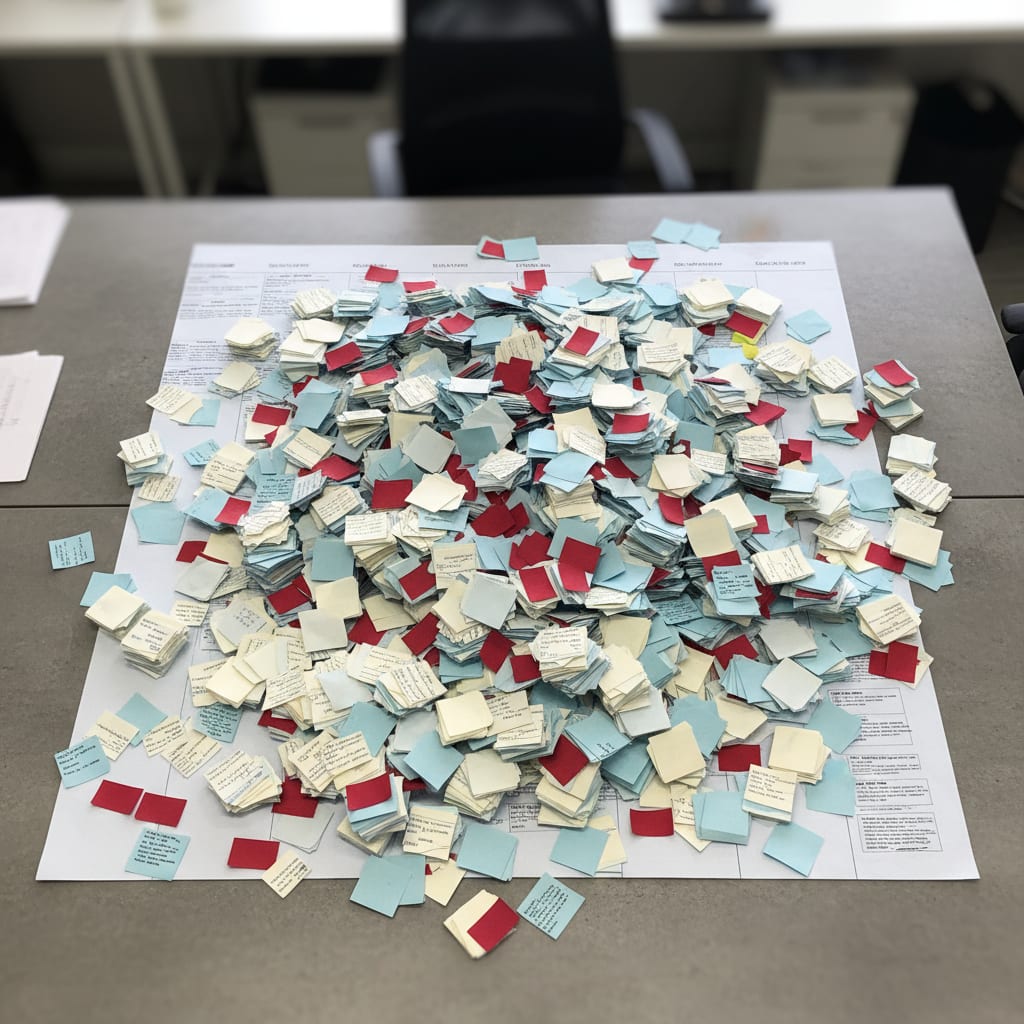
The retro board? Same sticky notes as three sprints ago. Action items untouched. According to Dejan Majkic (2024), an astonishing 70–80% of retrospective action items never make it into the next sprint–a gap known as "retro-to-sprint." The result? Three sprints of scope creep, a delayed release, and a lost deal. Worst of all: the early warning signs were sitting in the Trello board, ignored.
And it"s not just this company. ProProfs reports that 50% of teams spend at least a full workday each month manually merging project status info. If you"re too busy to analyze your own workflow data, you"ll never see these patterns forming.
So, how do you know if your team is crossing the line from normal messiness to real structural trouble? That"s where the five warning signals come in.
The 5 Early Warning Signs of GTM Misalignment
Let"s talk tools–and the chaos they create. In B2B SaaS teams with 50–200 people, the average team uses a staggering 87 different tools (saasoperations.com). On top of that, the average employee switches between apps 33 times a day.
According to the Lokalise Tool Fatigue Report, 2025, that context switching kills up to 40% of your productive work time. That"s 87 tools–and zero real insight. No wonder misalignment stays hidden until it"s too late.
Here"s the key: One signal alone is just noise. Three or more at the same time? That"s your threshold for structural misalignment.
Signal 1: Sales Requests Never Show Up in Sprints
Ask yourself: When"s the last time you saw a sales-driven feature request make it directly into a sprint, straight from the backlog–rather than bubbling up out of nowhere in a stakeholder update? If your answer is "basically never," you"re running two separate product roadmaps: one for Product, one for Sales. That"s the retro-to-sprint gap–a disconnect at the GTM level.
Signal 2: Customer Presentations Feature Unknown Functionality
This is the classic "but we agreed on this!" scenario. If sales decks are showcasing features that don"t exist in your backlog, there"s no Single Source of Truth–no up-to-date, shared view of what"s being built, what"s been promised, and what"s live with customers. A full 37% of companies lack this unified data source (Profisee). That means more surprises, more confusion, and more misalignment.
Signal 3: Stakeholders Are Lost in Sprint Reviews
Think back: When was your last sprint review where stakeholders had to ask what a feature was for–because there was no context, no numbers, no clear business link? That"s not just bad communication. That"s a sprint review with no data–and a dead giveaway that your work isn"t matching stakeholder expectations.
Signal 4: Roadmap Discussions Go in Endless Circles
Same sticky notes, same debates, quarter after quarter. The same features on the shortlist. The same arguments. No real progress. That"s not a prioritization issue–that"s a sign your teams aren"t sharing the same foundation: target market, customer profile, revenue potential. You"re not just arguing; you"re speaking different languages.
Signal 5: Sales and Product Use Different Metrics for the Same Period
This is the most reliable red flag. Think about "velocity." If Sales and Product both claim to track velocity for Q3–but cite completely different numbers–they"re not just reporting differently. They"re measuring success in fundamentally different ways. Alignment overhead keeps climbing as both sides waste hours debating what the numbers even mean.
According to Asana, knowledge workers estimate they could reclaim 4.9 hours per week with better processes. A big chunk of that? Wasted on exactly these kinds of metric debates.
Alignment overhead is all the time your teams spend syncing up–without actually creating value. In companies with GTM misalignment, alignment overhead spirals as everyone has to keep re-clarifying the same issues.
⚠️ Heads up: Ops PMs often misdiagnose GTM misalignment as a communication problem. The result? More meetings–which just crank up the alignment overhead and leave the root issue untouched. More coordination won"t fix a broken system.
Quick Checklist: Are You Facing Structural GTM Misalignment?
- Sales-driven feature requests rarely (or never) become sprint tasks
- Customer presentations include features Product doesn"t know about
- Stakeholders can"t contextualize sprint output in reviews
- Roadmap debates have dragged on for two or more quarters
- Sales and Product name different success metrics for the same period
How to score it: 1–2 yes answers = normal chaos. 3 or more = structural GTM misalignment. Time for a different approach–not just another meeting.
Self-Diagnosis: Is It Just Chaos, or Is It Systemic GTM Misalignment?
Knowing you have a problem is one thing. Figuring out how deep it runs is another. Here"s a simple traffic light framework to help you diagnose where your team stands.
| Diagnostic Question | 🟢 Green – Episodic | 🟡 Yellow – Pattern | 🔴 Red – Structural |
|---|---|---|---|
| How often does the problem appear? | Once or rarely | Every second sprint | Ongoing, every sprint |
| Escalation level? | Team-level, solved internally | PM-level, recurring | Leadership-level, unresolved |
| Customer impact? | None | Indirect (delays) | Direct (lost deals, churn) |
| How many teams are affected? | One team only | Two teams at once | Three or more teams |
| Can a conversation solve it? | Yes | Briefly, but recurs | No–it always comes back |
Green Zone: These are alignment hiccups that a good conversation straightens out. No need for drastic action.
Yellow Zone: This is the danger zone. Recurring patterns that demand a process change–but not yet a full-on strategic intervention. The trap? Yellow problems get normalized and ignored, silently draining your momentum for months.
Red Zone: This is structural misalignment–problems that only leadership can fix. Your job as Ops PM? Make the issue visible, escalate it with data, and don"t try to fix it alone.
Isn"t GTM Misalignment Always a Leadership Problem?
You"ll hear this argument a lot–and it"s half true. GTM misalignment is caused by strategic decisions (or indecision) at the top. No Ops PM can single-handedly fix a broken system.
But when it comes to early detection, the story changes. PMs are closer to the ground. You see the symptoms weeks or months before management ever notices. That gives you a unique responsibility: Spot patterns, name them, and escalate them–regardless of your title.
Here"s why it matters: The Freshworks Cost of Complexity Report (2025) found that software complexity costs companies an average of 7% of annual revenue. Even worse, 53% fail to realize the expected ROI from their tools. A big chunk of that? Wasted on GTM misalignment–buying tools for a strategy no one shares.
What To Do When You Spot GTM Misalignment
So, you"ve spotted the signals. Now what? Here"s what you, as an Ops PM, can realistically do–and what"s outside your lane.
Your role is clear: Make the problem visible and escalate it. The actual structural fix? That"s on leadership. Trying to solve a system-wide issue solo will burn you out–and won"t move the needle.
The stats back this up: According to Plaky PM Statistics (2026), 75% of project managers say they"re expected to do too much with too few resources. That"s not a coincidence–it"s a symptom of the same systemic issue. If you try to bridge the gap with personal heroics, you become part of the problem.
Ops PMs who see GTM misalignment but don"t escalate it end up stabilizing a dysfunctional system instead of surfacing the issue. Making misalignment visible isn"t optional–it"s the job.
The GTM Alignment Quick Audit: 3 Steps for Your Next Stakeholder Meeting
Before you escalate, you"ll need solid data–not just opinions or a list of complaints.
Here are three actionable steps:
Document and date every misalignment signal. Don"t just make a complaint list. Track specific patterns: date, team, signal, impact. Three data points across three sprints are more powerful than ten vague complaints.
Request a cross-team review with hard data. Skip the emotional escalation–no "This has been bad for months!" Instead, try: "I"ve observed this pattern over X sprints [with data]. Let"s review it together." This approach is non-accusatory and data-driven–and it works.
Prep for escalation. Identify the two internal stakeholders who need to see your pattern evidence before you bring it to leadership. Be clear: Who holds decision-making power? Who"s directly impacted day-to-day? For further reading, check out "When Misalignment Between Product and Sales Escalates" and "How to Systematically Improve Product-GTM Alignment" (plain text, no internal links).
FAQ: GTM Misalignment in Real SaaS Teams
Is GTM Misalignment Only a Problem for Big SaaS Teams?
Nope. In small teams (under 30 people), informal communication usually papers over misalignment–until you hit your first growth spurt. Once you reach 50+ employees and teams start sitting apart with their own goals, misalignment becomes structural. The warning signs stay the same, but the urgency ramps up as you scale.
How Long Does It Take for GTM Misalignment to Show Up in Revenue?
Typically, three to six months. Ops PMs spot the early signals much sooner–often two to four months before your sales pipeline or churn numbers react. That"s your critical window for intervention.
What"s the Difference Between GTM Misalignment and Stakeholder Misalignment?
Stakeholder alignment is about expectation gaps between individuals or groups–something you can usually fix at the team level. GTM misalignment is systemic: It affects your entire go-to-market engine (positioning, targeting, product promise). In fact, GTM misalignment often causes those downstream stakeholder issues.
If your self-diagnosis checklist turned up three or more "yes" answers, start today with Step 1: Document every signal with date and context. Not as an email. Not as a Slack rant. As a structured pattern record you can escalate.
By the way, according to Gartner (August 2025), by the end of 2026, roughly 40% of enterprise apps will have task-specific AI agents built in–up from less than 5% today. That"s going to transform how we spot misalignment: Sprint data, retro outputs, and stakeholder requests will be machine-analyzed, not hand-counted. If you master pattern-spotting now, you"ll be ready for that future–while others scramble to catch up.
SwiftRun.ai brings together your sprint data, retros, and stakeholder requests in a single view–so you can spot misalignment patterns before they blow up. See misalignment patterns before you have to fix them–free trial.
More reading:
- How to Improve Alignment Between Product and Sales/GTM Teams (plain text)
- What Is Stakeholder Alignment and How Do You Maintain It in Fast-Growing SaaS Teams? (plain text)
Ready to see the signals before they cost you real revenue? Start with your own backlog. You"ll be surprised what"s hiding in plain sight.
Related Articles:
- What Is Operational Intelligence–and Why Are SaaS PM Teams Making Bad Calls Without It Every Single Day?
- What Is Tool Sprawl? How SaaS Teams Lose 40% Productivity (And What to Do About It)
- Why Most PM Tools Fail at Flow Metrics–and What You Can Do About It
Ready to stop GTM misalignment from derailing your growth? Head over to SwiftRun.ai to discover how you can preemptively catch these issues and keep your SaaS revenue on track.
gtm misalignmentearly warning signsgo-to-market alignmentproduct sales alignmentsaas ops teamsrevenue miss
Related Articles

Operations & PM Teams
WIP Limits: Why Ops Teams Ignore Them at Their Peril
23 tasks 'In Progress', only one finished. That"s not bad luck–it"s Little"s Law in action. Here"s why WIP limits are the most important (and ignored) concept for Ops teams drowning in SaaS tools.
Jun 11, 2026·12 min read·Georg Singer
Operations & PM Teams
How to Fix Product and Sales Alignment in SaaS–Without New Tools
Product and Sales misalignment is the #1 reason SaaS revenue targets fail–according to Forrester. It"s a system problem, not a people problem. Here"s a four-part framework to sync Product and GTM, boost adoption, and eliminate wasted launches. No new tools required.
Jun 10, 2026·13 min read·Georg Singer

Operations & PM Teams
Flow Metrics: Why PM Tools Fail and How to Fix It
Velocity, Cycle Time, WIP–why do your retros go in circles while Trello, Asana, and Monday leave you flying blind? Discover what flow metrics really are, why they're missing from most PM tools, and how to unlock them for your ops team.
Jun 10, 2026·12 min read·Georg Singer